 THE AFRICAN COURIER. Reporting Africa and its Diaspora! The African Courier is an international magazine published in Germany to report on Africa and the Diaspora African experience. The first issue of the bimonthly magazine appeared on the newsstands on 15 February 1998. The African Courier is a communication forum for European-African political, economic and cultural exchanges, and a voice for Africa in Europe.
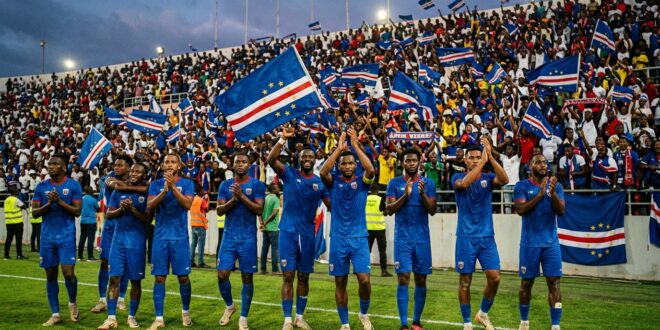
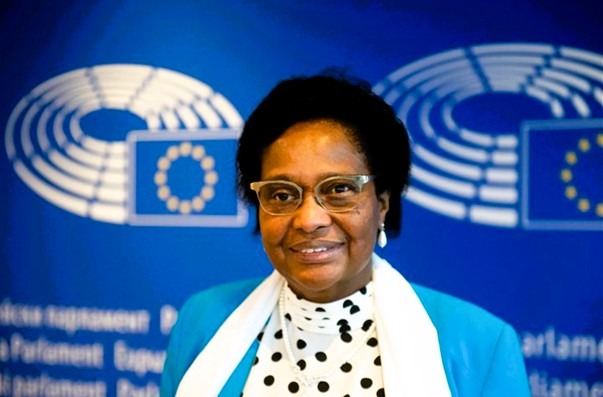
What does Cape Verde’s remarkable World Cup journey mean to its global diaspora? In this deeply personal reflection, renowned academic, former MEP and respected voice in the African diaspora in Europe, Dr Pierrette Herzberger-Fofana, explores how the Blue Sharks’ success became a powerful celebration of identity, belonging and pride for Cape Verdeans — and Africans everywhere.
The extraordinary journey of Cape Verde’s national football team at the FIFA World Cup is about far more than football. It is the story of a small island nation that has earned the admiration of millions through talent, resilience and dignity.
My mother loved to tell me a legend according to which, when God had finished creating the world, He shook His hands, and from them sprang the ten islands of Cape Verde. I love to believe in this legend that filled my childhood with wonder, just as I love to remember the ladainhas, those evenings of prayer, song, storytelling, festivities, and mystical, poetic incantations in praise of the saints and the country’s great figures.
Beyond the legend lies another remarkable history. The Cape Verde Islands, uninhabited until the fifteenth century, became one of the first societies created through the encounter of Africa and Europe. Located at the crossroads of the Atlantic, the archipelago developed a unique Creole civilization, shaped by African resilience, European influences and centuries of maritime exchanges. Despite centuries of hardship, drought and emigration, Cape Verde forged a strong national identity built on education, culture and solidarity.
No story about Cape Verde can be told without remembering Amílcar Cabral, one of Africa’s greatest thinkers and liberation leaders. His vision of freedom, dignity and education inspired not only the independence of Guinea-Bissau and Cape Verde but generations of Africans across the world. I named one of my sons after him. Thanks to the Blue Sharks, I no longer have to explain the significance of his name.
Today, the largest Cape Verdean community outside the archipelago lives in the United States. For generations, families have preserved the Creole language, music, traditions and deep attachment to the islands. Throughout this World Cup, from Lisbon to Dakar, Amsterdam to São Tomé, Luxembourg to Paris, Hamburg to Bissau, and across countless other cities around the world, Cape Verdean families celebrated every match as though they had returned home, to Praia, Mindelo, and the island of São Vicente.
The Blue Sharks reminded an entire diaspora that distance can never diminish belonging.
For me, however, this success is also deeply personal. It is the story of my family. It is also the story of millions of Cape Verdeans scattered across the world who have never stopped carrying the islands in their hearts.
My father was from Guinea-Conakry. I was born in Bamako, Mali, and grew up in Dakar, Senegal. Through my mother, I am Cape Verdean. I am also the granddaughter of Ñhu Nacu, one of the respected historical figures of Cape Verde, whose life has long symbolized the values of courage, public service and devotion to his people.
That is why every victory of the Blue Sharks resonates far beyond the football pitch. It touches my family’s history, the memory of my mother and the heritage of the islands that continue to shape my identity.
My mother would have been overjoyed to witness this historic moment. She would have been proud to see Cape Verde recognized around the world for its fair play during this World Cup. Today, the world sees a confident island nation whose football has earned global respect.

For decades, Cape Verde remained virtually unknown outside its diaspora. Many people could scarcely locate the archipelago on a map. Today, millions know its name because of its footballers.
The Blue Sharks have become the country’s finest ambassadors.
Through discipline, determination and exceptional talent, they have shown that greatness is never measured by territory or population. A nation of just over half a million people has demonstrated that excellence is born from commitment, vision and collective spirit.
Cape Verde’s achievement carries a broader message for Africa. It reminds the world that Africa is a continent of creativity, excellence, innovation and extraordinary human potential.
The Blue Sharks have inspired not only Cape Verdeans but millions across Africa and throughout the global African diaspora. Their journey has become a powerful symbol of hope for young people who dream beyond the limits that geography or history may appear to impose.
Football has a unique power. It crosses borders, languages and cultures. It unites people who may never meet yet celebrate the same victories. Few events create such a profound sense of shared humanity.
As the granddaughter of Ñhu Nacu, I feel immense pride today.
This is more than a sporting success.
It is a triumph of perseverance over adversity.
It is a victory for the international recognition of Cape Verde.
It is a tribute to generations of Cape Verdeans who built their future with courage, both on the islands and throughout the diaspora.
Just as Cesária Évora carried the soul of Cape Verde to the world through her music, the Blue Sharks have carried the pride of the nation through football. One made the world listen to Cape Verde. The other made the world admire it.
Cape Verde may not have lifted the World Cup trophy. Yet it achieved something that no statistics can measure. It won the respect of the world, strengthened the pride of its diaspora and reminded us all that greatness is never a question of size, but of courage, dignity and perseverance.
Like Amílcar Cabral and, later, Cesária Évora, the Blue Sharks have become new ambassadors of Cape Verde to the world.
The Blue Sharks have done more than win football matches.
They have won the world’s respect.
And that victory will endure long after the final whistle.