 THE AFRICAN COURIER. Reporting Africa and its Diaspora! The African Courier is an international magazine published in Germany to report on Africa and the Diaspora African experience. The first issue of the bimonthly magazine appeared on the newsstands on 15 February 1998. The African Courier is a communication forum for European-African political, economic and cultural exchanges, and a voice for Africa in Europe.
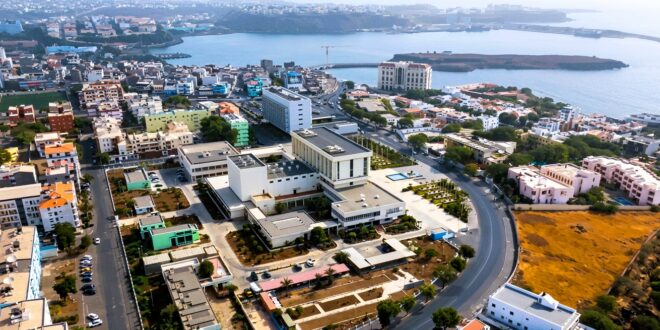
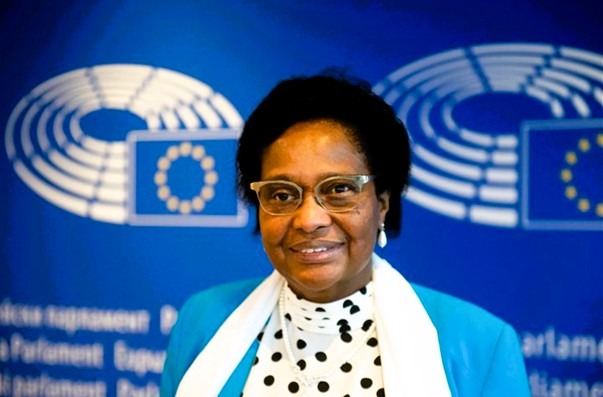
The 2026 World Cup will be remembered as the tournament in which a small island nation of fewer than 600,000 inhabitants compelled the world to reconsider some of its assumptions. It reminded us that, in the community of nations, greatness is determined neither by the size of a territory nor by the number of its inhabitants. Dr Pierrette Herzberger-Fofana, a former Member of the European Parliament, writes in this piece on how football can change the way the world sees a country, focusing on Cape Verde beyond its sporting achievement.

A Victory beyond Sport
Cape Verde did not win the 2026 FIFA World Cup. Yet it emerged as one of the great revelations of the tournament.
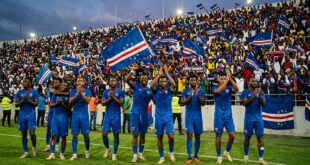
The Tubarões Azuis demonstrated that, in football as in life, greatness cannot be measured by the size of a country’s territory or the weight of its population. The Blue Sharks won the hearts of millions of supporters around the world. Cape Verde’s national team has written its name into the history of international football. It left the competition with its head held high and returned home proud of its achievements.
For a few extraordinary weeks, this Atlantic archipelago became the beating heart of a worldwide emotion. But to understand what this moment means, one must look beyond football. Towards Cape Verde history, its culture, its diaspora and the values that have enabled a small island nation to make its voice heard far beyond its shores.
The Legend of Cape Verde’s Creation
According to a legend my mother often told me, when God had finished creating the world, He shook His Hands above the Atlantic Ocean. From His hands fell ten fragments of earth, which became the ten islands of Cape Verde.
They were to symbolise the idea that human being must earn their bread by the sweat of their brow. This story about the origins of Cape Verde enchanted my childhood. It was passed down from generation to generation within my family and, to my knowledge, does not appear in any book.
I still like to believe in it.
And I remember the ladainhas filled with prayers, songs, stories, celebrations and mystical and poetic invocations honouring saints and great figure of the country.
I also remembered the singing and dancing of the batuku during wedding ceremonies, when cloth is used as a percussion instrument while a lead singer and chorus perform songs whose words often address social criticism, everyday life and historical events.
The archipelago itself is shaped by a dramatic volcanic landscape. Its ten islands seemingly defying wind and ocean, lie in the Atlantic some 450 kilometres off the African coast, at a crossroads between Africa, Europa and the Americas.
Nine of the ten islands are inhabited.
To the north lie the Barlavento, or Windward islands: Boa Vista, Sal, São Nicolau, Santo Antão, and São Vicente. To the south are the Sotavento, or Leeward islands: Brava, Fogo, Santiago and Maio. Each island has its own character. Sal is known for its sunshine: Boa Vista for its pleasant climate; Brava as the island of flowers; and Santiago, the largest and most populous island, for its fertile landscapes.
São Vicente, meanwhile, is one of the great centres of Cape Verdean music. The sounds of the morna, coladeira and funaná have crossed oceans, carried above all by Cesária Évora, the “Barefoot Diva” , whose voice came to embody the soul of Cape Verde.
Cape Verde’s history also helps explain its singular destiny.
Situated as the crossroads of Europe, Africa and the Americas, the archipelago was for centuries a meeting point of maritime routes, but also a placed marked by the transatlantic slave trade.
Out of hardship, drought, famine an emigration emerged a nation that learned to transform resilience into collective strength.

The Strength of a Global Diaspora
Cape Verde has one of Africa’s most transnational diasporas. Cape Verdeans are a people shaped by migration. Indeed, one of the country’s most striking characteristics is that more Cap Verdeans and people of Cap Verdean descent live abroad than on the islands themselves.
Large communities can be found in the United States, particularly in New England, as well as in Portugal, France, the Netherlands, Luxembourg and Belgium, in other Portuguese-speaking countries, and in neighbouring African countries such as Senegal.
In the United States, Rhode Island is home to a particularly vibrant Cape Verdean community. In Pawtucket, Cape Verdean culture is celebrated through music, dance and food. Community celebrations transform public spaces into open-air festivals, where cachupa, Cape Verde’s national dish, occupies a place of honour alongside traditional dance, concerts and songs.
Significant Cape Verdean communities can also be found in the Netherlands, Angola, Brazil and Senegal.
During the World Cup, those ties became visible to the entire world.
From one country to another, from one generation to the next, the diaspora followed the Blue Sharks with extraordinary passion. Football temporarily abolished geographical distance. Cape Verdeans scattered across continents found themselves united around the same flag, the same team and the same pride.
A Lesson for the World
Cape Verde’s journey reminds us that there is more than one way to be powerful.
The country possesses neither a vest territory nor immense natural resources. Its influence rests elsewhere.
First, there is its political stability.
Since independence on 5 July 1975, Cape Verde has developed into one of Africa most stable, democratic and peaceful countries. Political power has changed hands through elections, and multiparty democracy has become firmly established.
Political life is largely focused not on armed conflict but on the country’s considerable economic and environmental challenges: water scarcity, drought, the high cost of living and dependence on tourism.
Water or rather the lack of it has played a major role in the history of Cape Verdean emigration. The financial contribution of Cape Verdeans living abroad also remains an important factor in the country’s economic life.
Its geographical position brings other challenges. As an Atlantic archipelago, Cape Verde lies along international maritime routes and must confront transnational trafficking through cooperation with international partners. Fishing and the sea remain central to the country’s economy and identity.
But another source of Cape Verdean strength deserves particular attention: education and the values attached to work.
Work occupies a central place in Cape Verdean family culture. Parents pass this value on to their children from an early age. Many Cape Verdean women of an older generation tell stories of having worked hard throughout their lives to raise their children, particularly when fathers had emigrated in search of employment. Pride in work well done can also be found in the many proverbs and expressions that punctuate everyday speech.
One principle captures this attitude particularly well:
“What is excellent is just good enough for me. I can therefore demand nothing less than excellence from my own work.”
Education combined with an active diaspora, has helped transmit Cape Verdean culture far beyond the islands.
And few people have contributed more to its worldwide recognition than Cesária Évora
Cape Verdean Creole kriolu, is the mother tongue of the population, while Portuguese is the language of administration and formal education.
Through her music, Cesária Évora introduced millions of people to the morna, those gentle, melancholic songs that express something profound about the Cape Verdean soul.
Her famous Sodade became an emblem of Cape Verdean music and of the longing experienced by generations shaped by departure and migration.
The morna might be described as Cape Verde ’s tradition blues, and Cesária Évora was its undisputed queen.
Songs such as Petit Pays, Sangue de Beirona and Angola carry different aspects of Cape Verdean history, memory and identity across linguistic and national borders.
Cape Verde, in turn, honoured Cesária Évora by placing her portrait on its 2,000 escudo banknote.
Long before football brought the islands to a new global audience, music had already carried Cape Verde around the world.
The Legacy of Amilcar Cabral
One cannot tell the story of Cape Verde without remembering Amilcar Cabral, one of the most important thinkers and leaders of the liberation struggles of Guinea Bissau and Cape Verde.
Born on 12 September 1924 in Bafata, in what was then Portuguese Guinea, to Cape Verdean parents, Cabral left for Portugal in 1945 to study agronomy. Together with other activists, he later founded the African Party for the Independence of Guinea and Cape Verde, the PAIGC.
Cabral was assassinated in Conakry in January 1973, only months before Guinea Bissau proclaimed its independence. He did not live to see the full realisation of the liberation for which he had struggled.
Yet his vision of freedom, dignity, culture and education inspired not only the independence movements of Guinea-Bissau and Cape Verde, but generations of Africans throughout the world.
His legacy is also part of my own family history.
In honour of this hero of freedom, I gave one of my sons his name.
For years, that name often required an explanation. Who was Amilcar Cabral? Where exactly is Cape Verde?.
Thanks to the Tubarões Azuis, I suspect I will have to explain the second question far less often.
Cape Verde’s main international airport on the island of Sal bears Cabral’s name. Football has now made visible to millions what history and culture had already created.
And football has revealed Cape Verde to a wider world , this success did not emerge from nowhere. It is rooted in a history, a culture and a conception of freedom that have shaped the country for generations.

A Personal Legacy
For me, this story is also shaped deeply personal.
I was born in Bamako and grew up in Dakar. My father came from Guinea-Conakry, and my mother was Cape Verdean.
Through my mother, I am the granddaughter of Ñhu Nacu, one of Cape Verde’s respected historical figures, whose embodied courage, commitment to public service and dedication to his people.
This is why the adventure of the Tubarões Azuis means far more to me than football.
With every victory, memories returned, memories of my mother, of my childhood and of those islands that have never ceased to live within me.
How I wish my mother could have witnesses this moment, when people around the world were applauding the country, she loved so dearly.
The Victory of Small Nations
Cape Verdeans are a warm and welcoming people whose haunting, nostalgic music tells the story of an archipelago shaped by departure, memory resilience and hope.
Their presence at the World Cup was celebrated far beyond their own shores. The Blue Sharks offered the world another image of Africa, one of talent, dignity, perseverance and pride.
Cape Verde may not have won the world Cup. But it won something that appears in no FIFA ranking, the respect of admiration of millions of people.
At a time when power and greatness are too often confused, the Tubarões Azuis, remind us that small country can change the way the world sees it when it reveals its talent, resilience and strength.
Their journey belongs not only to Cape Verde.
It is a victory to every small nation that refuses to be condemned to invisibility.
_____________
The author, Dr Pierrette Herzberger-Fofana, is an Honorary Citizen of Erlangen and a former Member of the European Parliament (2019–2024). During her tenure, she served as First Vice-Chair of the Committee on Development and Co-President of the European Parliament’s Anti-Racism and Diversity Intergroup (ARDI). A specialist in racism, the duty of remembrance and women in development, Dr Herzberger-Fofana holds two master’s degrees: one in German studies (German sociology) from the Sorbonne in Paris and another in sociolinguistics from the University of Trier (Germany). She earned her PhD in Francophone women’s literature at the Friedrich-Alexander University of Erlangen-Nuremberg. Her revised thesis, published as “Littérature féminine francophone d’Afrique Noire” (Paris: L’Harmattan), was awarded the ‘Grand Prix of the President of the Republic of Senegal for Science’ in Dakar in 2003. She also received the Helene Weber Prize, presented by the President of the European Commission in Berlin in 2009 (see www.grioo.com/info11494.html and www.grioo.com/info1406.html).
READ ALSO The Blue Sharks: How Cape Verde Won the Heart of the World