 THE AFRICAN COURIER. Reporting Africa and its Diaspora! The African Courier is an international magazine published in Germany to report on Africa and the Diaspora African experience. The first issue of the bimonthly magazine appeared on the newsstands on 15 February 1998. The African Courier is a communication forum for European-African political, economic and cultural exchanges, and a voice for Africa in Europe.

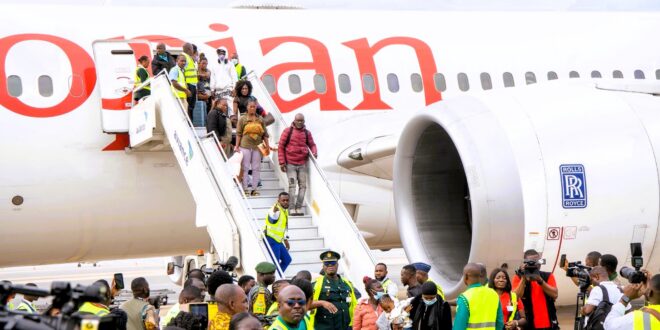
Ghana has begun evacuating hundreds of its citizens from South Africa following renewed anti-immigrant protests and fears of xenophobic violence in the country.
The first chartered flight carrying 297 Ghanaians landed in Accra on Wednesday as part of a voluntary repatriation programme approved by President John Dramani Mahama. Ghanaian authorities say more than 800 nationals have registered to return home from South Africa amid growing insecurity and hostility towards foreigners. There are about 25,000 Ghanaians living in South Africa, the continent’s most industrialised economy, according to reports.
Welcoming the evacuees at Accra International Airport, Ghana’s Foreign Minister Samuel Okudzeto Ablakwa said the government had a duty to protect its citizens abroad and announced reintegration measures, including financial assistance, psychosocial support and employment opportunities.
The evacuation follows weeks of protests organised by the anti-immigration movement “March and March”, which accuses undocumented migrants of contributing to crime, unemployment and pressure on public services. Demonstrators have reportedly issued a 30 June deadline for undocumented foreigners to leave the country.
South Africa has long been experiencing periodic outbreaks of xenophobic violence. In 2008, attacks on foreign nationals left at least 62 people dead, while another wave of violence in 2019 killed at least 12 people and displaced thousands. Migrants from Zimbabwe, Nigeria, Mozambique, Ethiopia, Somalia, the Democratic Republic of Congo and other African countries have frequently been targeted.
The current tensions are unfolding against the backdrop of severe economic pressures. South Africa’s unemployment rate remains above 30 percent, one of the highest in the world, with youth unemployment even higher. Analysts say migrants are increasingly being scapegoated for broader structural problems including inequality, weak service delivery and slow economic growth.
Although South African authorities have condemned violence against foreigners and pledged to uphold constitutional protections, the Ghanaian evacuation marks one of the strongest diplomatic responses yet by an African government to the resurgence of xenophobia in the country.
The development could also have wider implications for other African nationals living in South Africa. Nigeria has already indicated that some of its citizens are seeking repatriation, while migrant communities from other African countries are reportedly becoming increasingly anxious.
Migration experts warn that if tensions continue to escalate, more African governments may come under pressure to organise evacuations. Such a scenario could deepen diplomatic strains within Africa at a time when the continent is promoting greater regional integration through initiatives such as the African Continental Free Trade Area (AfCFTA).
For many observers, the sight of African governments evacuating their citizens from another African country is a troubling reminder of the fragility of Pan-African solidarity in times of economic and political stress.
Adira Kallo
READ MORE The Deeper Crisis Beyond South Africa’s Anti-Migrant Violence