 THE AFRICAN COURIER. Reporting Africa and its Diaspora! The African Courier is an international magazine published in Germany to report on Africa and the Diaspora African experience. The first issue of the bimonthly magazine appeared on the newsstands on 15 February 1998. The African Courier is a communication forum for European-African political, economic and cultural exchanges, and a voice for Africa in Europe.

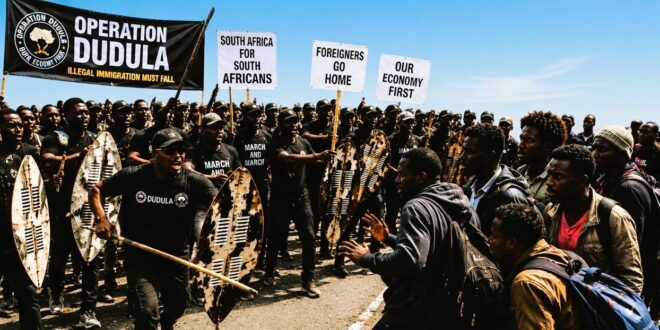
Shocking scenes of anti-migrant violence in South Africa expose more than xenophobia; they reveal a deeper continental crisis. Beneath the brutality lies failed governance, economic despair and broken promises across Africa. This moment demands not only outrage, but honest reflection on leadership, accountability and the urgent need for systemic transformation in the continent, argues Femi Awoniyi
The images of African migrants being harassed and beaten by mobs in South Africa are atrocious. Hoodlums parading the streets and harassing innocent and defenceless people with little or no challenge from law enforcement agents.
Some of these anti-migrant groups even invade hospitals, ordering non-South African nationals to leave. Parents have also complained of their children being harassed in schools. Two Nigerians and four Ethiopians have reportedly been killed during the latest wave of lawlessness that should shame South Africa and its leaders.
Remembering how the liberation of South Africa became a continental cause, and how the whole continent stood by its Black citizens during their most trying period, one wonders why the country’s leaders would allow this regularly recurring macabre show to go on unchecked.
The latest outbreak of anti-migrant violence in South Africa should make us deeply sad. And not only because of the tragic paradox of Black South Africans attacking Black people from other parts of the continent — in a country with such a history of racial oppression by whites — but also because these events poignantly bring again to the fore the failure of government in many African countries whose disaffected citizens are being pushed daily to seek a better life elsewhere, and anywhere at all.
It is a bitter truth that the post-apartheid, Black-majority government in South Africa has not fully lived up to the expectations of its people, and that some politicians now shamelessly and unscrupulously scapegoat African migrants for their own failures.
It is also a bitter truth that South Africa cannot take in all the victims of bad governance from the rest of the continent.
After the expression of our justified outrage and protestations, the latest outbreak of anti-African migrant violence in South Africa should force us to reflect on the current reality of our continent.
‘Africa Rising’ and Afro-Pessemism
About two decades ago, the song of ‘Africa Rising’ was on every lip. The narrative became so powerful that it served as an antidote to the unfortunate and infamous “Hopeless Continent” characterisation of Africa by The Economist in its May 13, 2000 edition — which rightly caused widespread outrage across Africa and its diaspora.
African journalists and intellectuals rose to challenge that narrative. They wrote about the increasingly peaceful and democratic Africa, and the continent’s immense natural wealth and its youthful population poised to shape the future. They pointed to a growing middle class in many countries and increasing trade with China and the resulting signature infrastructure projects, assuring that a glowing, prosperous future was on the horizon.
Fast forward twenty years, and many countries that held so much promise then are mired in conflicts. As I write this, 17 African countries are engulfed in one conflict or another. You will labour in vain to count up to ten African countries that are real democracies — in which opposition parties operate unfettered and in which credible elections are held regularly. Most are democracies in name only, with entrenched ruling parties that are all but impossible to vote out of office.
Elections have become shams and institutions that should protect democracy have become willing tools in the hands of power holders across much of Africa.
Today, the situation on the continent is eliciting the old Afro-pessimist resignation that we once thought had been banished forever.
Yet we face monumental challenges. We have the highest population growth rates in the world, unmatched by corresponding economic growth and development.
In places like the West African Sahel, DR Congo, Sudan, and South Sudan, conflicts continue to displace tens of millions of people, with no solution in sight. Nigeria, the supposed continental giant, is so weakened that it has been unable to defeat a lunatic Islamist insurgency fifteen years on.
Worse still, militants with various motives — also called armed bandits — have joined Boko Haram terrorists in rendering large swathes of the country unsafe, making it almost impossible for millions of rural dwellers to live in peace and security, talk less of pursuing economic activities.
In these conditions, we cannot have real development, and the future can only appear perilously uncertain. This explains the mass youth unemployment in many countries, because the moderate economic growth rates even in the better-off countries, chiefly based on the extractive industries, haven’t and can’t produce enough jobs. This is the cause of migration across Africa.
Crisis of governance
At the heart of the problem is the crisis of the state in Africa. It’s a weak institution that can’t fulfil its basic function of properly administering nations. People in government and politics are there primarily for self-service instead of public service.
Unfortunately, it’s the culture in postcolonial Africa that people in leadership often treat their countries as personal possessions to exploit — like conquered territory or war spoils — rather than seeing themselves as custodians responsible for the well-being and future of their nations.
Many African countries are net importers of food, even though they could in fact become large exporters of food. Africa imports food worth over 50 billion dollars annually because the state is so weak to lead countries to become self-sufficient producers. Yet, agriculture is the lowest-hanging fruit of development, with the paradox of the continent boasting 60% of the world’s arable land yet to be cultivated.
How can Africa develop modern industries to produce vehicles, machines, electronics, chemicals and pharmaceuticals when it can’t grow food to feed itself?
Listening recently to Mo Ibrahim, founder of the Mo Ibrahim Foundation, strike an unusually pessimistic tone should make us think. A man long seen as one of the continent’s leading optimists now describes his generation as having failed in handing over a forward-looking Africa to the next.
These are the issues the latest bout of anti-migrant violence in South Africa should compel us to ponder. And we have to face the fact that Africa cannot continue to be governed like it’s presently being done.
The author, Femi Awoniyi, is the Editor of The African Courier