 THE AFRICAN COURIER. Reporting Africa and its Diaspora! The African Courier is an international magazine published in Germany to report on Africa and the Diaspora African experience. The first issue of the bimonthly magazine appeared on the newsstands on 15 February 1998. The African Courier is a communication forum for European-African political, economic and cultural exchanges, and a voice for Africa in Europe.

The Interview That Became a Debate
By Collins Nweke
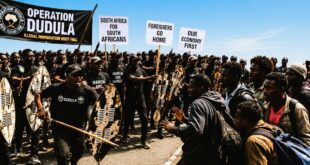
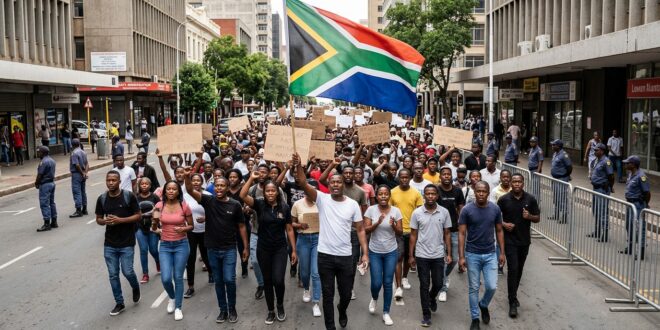
When I accepted an invitation for a live interview on News Central TV — an independent 24-hour news channel based in Lagos that focuses on Nigerian and African affairs — I expected my usual engaging conversation with a team of three brilliant anchors. But within minutes of going live, it became clear that what had been presented as a discussion on migration had turned into something entirely different. Appearing opposite me was a South African Member of Parliament, Sihle Ngubane, defending his MK Party’s support for the latest anti-immigrant protests in his country.
Suddenly, this was no longer an interview. It had become a debate about Africa itself. The experience reminded me of something I have come to appreciate after years of analysing global affairs: the most important public debates are rarely about the issues they appear to be discussing. It was, in fact, a debate about governance, constitutional authority, political opportunism, and the future of Pan-Africanism.
The distinction Africa must never lose
From the outset, I made what I consider an indispensable distinction. Every sovereign nation possesses the unquestionable right to regulate its borders, enforce its immigration laws, and determine who may legally reside within its territory. That principle is beyond dispute. But an equally important principle is beyond dispute too: No political movement, civic organisation, neighbourhood association, or self-appointed vigilante group acquires the authority to enforce those laws. The monopoly of lawful coercion belongs to the state.
The moment ordinary citizens begin stopping strangers on the streets and in hospitals, demanding identity documents, deciding who belongs and who does not, who accesses healthcare and who not, and intimidating those they suspect of being foreigners, immigration policy has ceased to be an instrument of governance. It has dangerously become an instrument of mob rule. That distinction is not merely legal. It is civilisational. This is because a democracy cannot outsource law enforcement to public anger.
The politics beneath the protests
One observation from the interview deserves deeper reflection. Migration has become one of the most politically useful issues in democratic politics. Europe has experienced it and is still experiencing it. The same for North America. Increasingly, Africa is experiencing it too.
Whenever unemployment rises, public services deteriorate, housing shortages deepen, and inequality widens, migrants become politically convenient explanations for problems that governments have failed to solve. South Africa is hardly unique in this respect. But it is especially vulnerable because it remains one of the world’s most unequal societies. Millions of frustrated citizens understandably seek answers. Unfortunately, frustrated societies sometimes accept the easiest explanation instead of the correct one. Migrants become scapegoats. Governance escapes scrutiny.
Numbers matter
One moment during the debate particularly illustrated why evidence matters. The discussion repeatedly referred to undocumented migration as though it constituted an overwhelming proportion of South Africa’s population. Yet the available evidence suggests otherwise. The overwhelming majority of people living in South Africa are South African citizens. Even the foreign-born population represents only a small share of the total population, while undocumented migrants constitute an even smaller fraction.
This does not eliminate legitimate concerns about immigration enforcement. It simply means that the political narrative must remain proportionate to the empirical reality. Good policy begins with facts. Poor politics often begins with fear.
When rhetoric becomes permission
Perhaps the most dangerous aspect of contemporary migration politics is not violence itself. It is rhetoric that unintentionally legitimises violence. Political leaders may condemn killings after they occur. But when public speeches repeatedly portray undocumented migrants as the primary cause of unemployment, crime, collapsing public services, or declining living standards, some listeners inevitably conclude that removing migrants becomes a patriotic duty.
Words create political permission. History has demonstrated this repeatedly. Responsible leadership therefore requires extraordinary precision. Governments should condemn illegal immigration where it exists. They must never encourage hostility towards immigrants.
The contradiction confronting Africa
The African Union celebrates continental integration. The African Continental Free Trade Area promises the world’s largest free trade area. Regional economic communities speak enthusiastically about labour mobility. Yet Africa remains institutionally unprepared for African migration.
Goods increasingly move across borders. Capital increasingly moves across borders. Ideas increasingly move across borders. People, however. If immigration enforcement becomes privatised by street movements, every African travelling, studying, investing, or working elsewhere on the continent becomes vulnerable. That would undermine not only Pan-Africanism but also the economic ambitions embodied in AfCFTA.
Continental integration cannot flourish where continental suspicion thrives.
Conclusion
As the programme ended, I found myself reflecting less on the debate itself than on what it revealed. Africa stands at an important crossroads. One path leads towards stronger institutions, lawful immigration systems, accountable governments, and deeper continental cooperation. The other leads towards populism, scapegoating, vigilantism, and a gradual erosion of the ideals upon which modern African unity was built. The choice should not be difficult. Immigration enforcement is a function of the state. Mob enforcement is a confession of state failure.
And Africa cannot build a continental market while permitting a continental fear of one another to take root.
A full playback of the Breakfast Central interview on News Central TV is available here.
READ ALSO The Deeper Crisis Beyond South Africa’s Anti-Migrant Violence