 THE AFRICAN COURIER. Reporting Africa and its Diaspora! The African Courier is an international magazine published in Germany to report on Africa and the Diaspora African experience. The first issue of the bimonthly magazine appeared on the newsstands on 15 February 1998. The African Courier is a communication forum for European-African political, economic and cultural exchanges, and a voice for Africa in Europe.

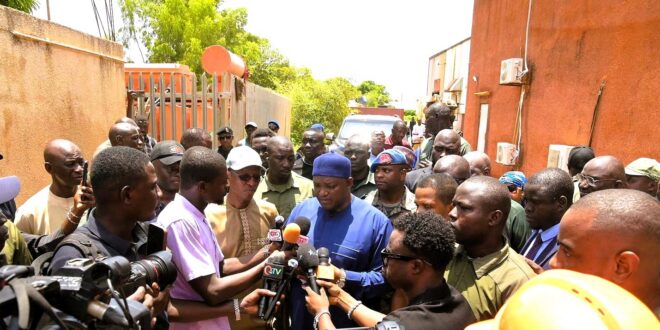
Businesses struggle, residents protest and the government pledges to tackle Gambia’s worsening electricity crisis by building a 24-megawatt plant. Nyima Jadama reports
Since summer this year, Gambians have faced a power supply crisis, disrupting businesses and daily activities of citizens. The frequent blackouts force businesses and households to cope without electricity for days.
Banjul, the country’s capital, is experiencing frustration over electricity shortages that has led to protests with at least 20 arrests in September. The rolling blackout also prompted protesters in various cities across the country to burn tires and build barricades blocking traffic, demanding that President Adama Barrow resign. Police used tear gas to disperse crowds who gathered in multiple locations, including near the president and vice president’s residences and the National Water and Electricity Corporation (NAWEC) headquarters, which supplies the country’s electricity.
President Barrow has pledged improvements to the country’s unreliable power supply. The country’s main power provider, NAWEC, says the outage is the result of rising demand, limits on electricity imports and technical challenges. The company further warned in August that extreme heat had sent demand soaring and a fault had knocked out one of the main units supplying power from abroad.
The small West African nation is still struggling to generate enough electricity domestically, so it relies on imports from neighboring Senegal and Guinea. The Gambia has endured persistent blackouts since June, with outages becoming longer and more frequent during the current hot season as soaring temperatures drive up electricity demand.
Affected business owners like Bakary Kebe say they now rely on candles and the torchlight on their mobile phones to work inside their darkened shops in Serekunda, where persistent power cuts are disrupting businesses and daily life. Small business owners say frequent outages are damaging equipment, delaying work and making it harder to earn a living.
Residents say the shortages are also affecting life at home and forcing many to rely on candles and battery-powered lights during the hottest months of the year. While diaspora members struggle to communicate with families back home, Ebrima Darboe, who is based in Germany, said he sometimes has no contact with his family for over 48 hours due to the ongoing electricity crisis, and urged the government to strengthen its efforts to end it.
Fattoumatta Corker, frustratingly stated, “The crisis is affecting all of us. Life in The Gambia is already difficult, and while some people say this is only a minor problem, those who are better off are comfortable, while poor people like us are suffering”.
In his televised address, President Barrow admitted that the government had fallen short in planning, generation and maintenance. He called the blackouts a national security issue and an emergency, but also said The Gambia isn’t the only West African country in this position. “Let us not destroy in a moment of anger what we suffered so long to gain,” he said. “I know that the fans have stopped turning, children work in the dark, mothers throw away stale food, and the heat is unbearable day and night,” the president said, promising that supplies would improve by the end of October.
As part of the effort to halt the ongoing crisis, the president visited facilities for the national energy utility days after the nation’s protest and promised that The Gambia would receive new generators that week.
The unrest comes just months before a presidential election expected in December, in which Barrow is seeking a controversial third term. Some opposition leaders criticized the government’s handling of the crisis, arguing that Gambia’s electricity challenges should be manageable, given the country’s relatively small energy needs.