 THE AFRICAN COURIER. Reporting Africa and its Diaspora! The African Courier is an international magazine published in Germany to report on Africa and the Diaspora African experience. The first issue of the bimonthly magazine appeared on the newsstands on 15 February 1998. The African Courier is a communication forum for European-African political, economic and cultural exchanges, and a voice for Africa in Europe.

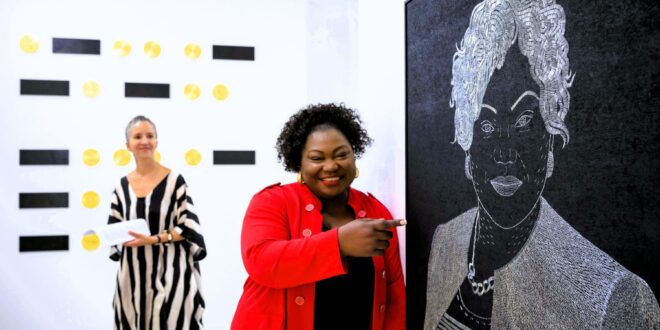
When Dr Sylvie Nantcha entered Freiburg’s city council in 2009, her election was more than a personal political achievement. She became the first Afro-German CDU councillor elected to a municipal parliament in Germany. Seventeen years later, that pioneering role has been turned into art.
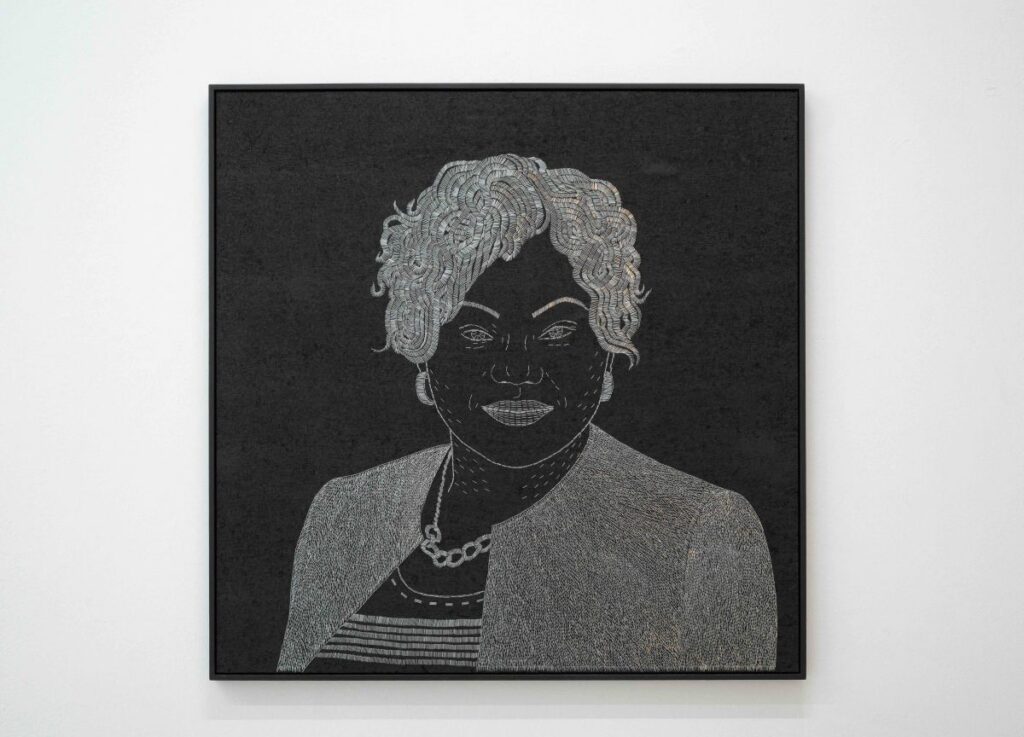
Swiss-Haitian artist Sasha Huber has portrayed Nantcha as part of her international The Firsts series, which honours Black people who have broken historical barriers and created opportunities for those who followed them.
The large-format portrait, The Firsts – Sylvie Nantcha, was unveiled on 17 September before around 100 guests at the E-WERK Freiburg, where it forms part of Huber and Petri Saarikko’s exhibition SHELTER.
The exhibition, which runs until 8 November, is the artists’ first exhibition in Germany. E-WERK describes SHELTER as part of Huber and Saarikko’s decolonial artistic practice, addressing contested histories and their continuing political and material effects.
From Cameroon to the Freiburg council
Nantcha’s story began far from the German political establishment. Born in Cameroon in 1974, she came to Freiburg in 1992 at the age of 17 to study. She subsequently studied German, Romance languages and linguistics at the University of Freiburg and completed a doctorate in intercultural German studies.
The City of Freiburg has described her academic and educational career as the foundation for her later political engagement. She worked with international students and doctoral candidates at the university before entering local politics.
In 2009, she was elected to the Freiburg Gemeinderat for the CDU, becoming Germany’s first Afro-German CDU municipal councillor. She was also elected in 2009 to the CDU’s Baden-Württemberg state executive — again as the first Afro-German in that position.
Her political work in Freiburg included education, migration and integration, environmental issues and economic development. She was involved in establishing a municipal framework for migration and integration and played an important role in creating Freiburg’s Integration Prize. In 2011 she received the Helene Weber Prize, awarded to women for outstanding commitment in local politics.
“I was perhaps the first — but I don’t want to remain the only one”
The words Nantcha chose at the unveiling gave the portrait a meaning extending well beyond her own biography. “Being a first does not mean standing alone at the top. It means opening a door and making sure that it remains open for others.”
She added: “I was perhaps the first – but I don’t want to remain the only one.”
It is a particularly relevant message in a country in which political representation has become more diverse but where Germans of African descent remain underrepresented in many institutions.
Huber’s artistic treatment adds another layer to the story.
Metal staples incorporated into the portrait represent historical wounds. At the same time, they symbolise the stitching together of those wounds and the possibility of healing.
That symbolism connects Nantcha’s personal trajectory with the broader themes of SHELTER.
For Nantcha, the question of belonging is central to that discussion.
At the unveiling she declared:
“I have never regretted coming to Germany and becoming German. I am happy to be German.” And she made the point in particularly emphatic terms: “With my German passport, I am not a German of the second class. I belong to this country.”
The statement echoes a theme she has articulated for years.
In a 2020 account of her life published by SWR, Nantcha wrote about living between cultures and described herself as a German with African roots. In 2018, she worked with the City of Freiburg on a citizenship campaign under the motto “Ich bin gerne Deutsche” — “I am happy to be German.”
The message was not one of choosing between African and German identity but of insisting that the two can coexist.
“The door is also open for you”
Nantcha used the occasion of the exhibition’s opening to address young people growing up in Germany.
She told them that the country’s future would increasingly be shaped by people with migration backgrounds and encouraged young people to use the opportunities available to them even when the path is difficult.
“You may fall, but you can get up again,” she said, urging the younger generation not to give up.
“Germany needs your voices, your experiences and your talents.”
The appeal has particular resonance for young people of African descent who have grown up in Germany but can still encounter questions about whether they are “really German”.
From local politician to national advocate
Nantcha’s work has also evolved considerably since her years in the Freiburg council.
She is the founder and federal chair of TANG – The African Network of Germany, an umbrella body representing African organisations and individuals in Germany.
That evolution — from municipal councillor to national-level community advocate — is an important part of why Huber’s The Firsts portrait carries significance beyond the Freiburg art scene.
The portrait also arrives at a time when questions of race, representation and belonging remain prominent in German public debate.
Germany has a long-established Black population, including descendants of people who have lived in the country for generations, alongside more recent migrants and their children.
At the same time, increased visibility has not eliminated discrimination.
The political question is therefore not simply whether people of African descent are now visible in German institutions. It is whether that visibility translates into sustained participation, influence and equal recognition.
Nantcha’s own career illustrates both sides of the story: she broke barriers in German local politics, but she has also spoken publicly about racism and the continuing need to create opportunities for those who come after her.
Vivian Asamoah
____
The exhibition SHELTER by Sasha Huber and Petri Saarikko is on view at E-WERK Freiburg through November 8, 2026. Admission to the exhibition is free.