 THE AFRICAN COURIER. Reporting Africa and its Diaspora! The African Courier is an international magazine published in Germany to report on Africa and the Diaspora African experience. The first issue of the bimonthly magazine appeared on the newsstands on 15 February 1998. The African Courier is a communication forum for European-African political, economic and cultural exchanges, and a voice for Africa in Europe.

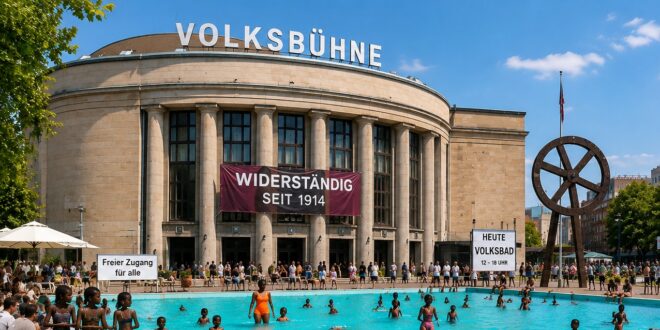
Since 7 August, a temporary 25-metre open-air pool, the ‘Volksbad’, has stood outside Berlin’s Volksbühne theatre as part of an art installation by artistic director Matthias Lilienthal. Entry is free, but as at many public pools, the basin is reserved for particular groups on certain days. Each One Teach One (EOTO), a Berlin organisation supporting people of African descent, had booked the pool exclusively for Black children and young people on Friday, 15 August, from midday to 6pm, before it reopened to the public.
The plan drew public criticism, most prominently from Aileen Weibeler, a CDU district councillor for Berlin-Pankow. Tabloid and mainstream outlets including Bild and Welt picked up the story, and an intense backlash followed on social media.
EOTO said it received threatening messages and racist, discriminatory comments. On 14 August, the Volksbühne and EOTO jointly cancelled the swimming afternoon, citing safety concerns for participants and staff.
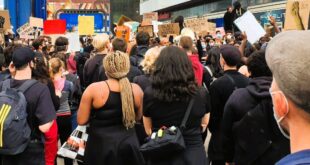
The cancellation has triggered a further round of debate over racism, privilege and so-called safe spaces in Germany, and a solidarity demonstration outside the Volksbühne drew several hundred people the following week.
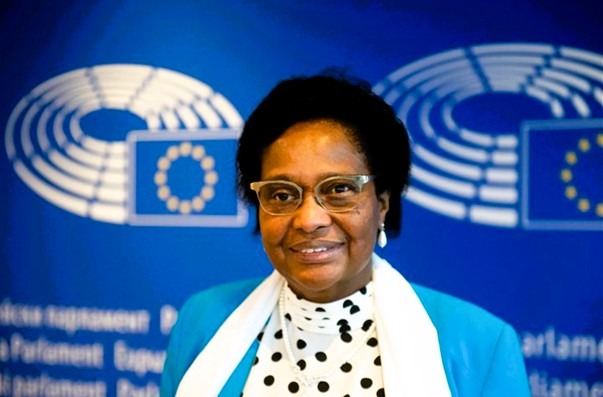
Dr Pierrette Herzberger-Fofana, a former member of the European Parliament, responds to the controversy below.

A swimming event in Berlin designed to give Black children and young people a temporary safe space had to be cancelled after racist threats made it impossible to guarantee participants’ safety. The event, organised by Each One Teach One (EOTO), was meant to give children and young people a few carefree hours together during the summer holidays. Instead, it became the focus of a heated public and political controversy.
I was deeply dismayed to learn that the EOTO swimming event for Black children and young people had to be cancelled because their safety could no longer be guaranteed following racist threats.
I am angry and saddened. What was meant to be a carefree summer holiday experience for children became the subject of a heated political debate. And it is the children who ultimately paid the price.
The public controversy was triggered by criticism from Aileen Weibeler, a CDU district councillor in Berlin-Pankow, of the temporary safe-space initiative. In the ensuing debate, the actual purpose of the event was increasingly lost from sight: to give Black children and young people a protected space for a few hours where they could swim, play and enjoy their summer holidays together without racist remarks, exclusion or people touching their hair without permission.
A safe space is not exclusion
Temporary protected spaces for particular groups are nothing unusual in our society. We are familiar with activities and spaces reserved for women, senior citizens, children and young people, as well as private events organised by associations and other groups. They are accepted because they serve a specific purpose. Why, then, does a safe space specifically for Black children provoke such outrage? That is the question we should be asking.
EOTO has been doing important cultural and educational work for Black communities, particularly children and young people, for many years. I know EOTO personally, have attended several of its events and greatly appreciate the organisation’s commitment and work.
The organisers simply wanted to give children spending their summer holidays at home a few enjoyable and carefree hours. Instead, a public controversy developed that ultimately led to the cancellation of the event on safety grounds. That, to me, is the real scandal.
We are witnessing a disturbing societal rollback in Germany and across Europe. Racist attitudes, and anti-Black racism in particular, are once again being expressed more openly. This is precisely why politicians have a special responsibility for their words and for the impact that public debates can have.
Political controversies must not be fought at the expense of children
Anyone who questions the need for safe spaces for Black children should first ask why these children need such spaces in the first place. They do not need them because they want to separate themselves from society. They need them because they still experience racism and discrimination in our society.
My solidarity goes to Each One Teach One (EOTO), to the dedicated staff and volunteers, and above all to the Black children and young people who were deprived of their day at the swimming pool and of their safe space.
Anti-Black racism has many faces. It is not only expressed through overt insults and attacks. It also manifests itself when necessary safe spaces are called into question and those seeking protection from discrimination suddenly find themselves accused of discrimination.
The United Nations did not proclaim the Second International Decade for People of African Descent (2025–2034) without reason. Recognition, justice and development remain essential tasks for our societies. Our responsibility is to combat racism, protect children and strengthen social cohesion.
At the end of this controversy, one bitter fact remains: it was not a politician who lost access to a swimming pool. Black children lost their safe space. Black children have the right to safety, joy and carefree moments. At the swimming pool, too.
______
The author, Dr Pierrette Herzberger-Fofana, is an Honorary Citizen of Erlangen and a former Member of the European Parliament (2019–2024). During her tenure, she served as First Vice-Chair of the Committee on Development and Co-President of the European Parliament’s Anti-Racism and Diversity Intergroup (ARDI). A specialist in racism, the duty of remembrance and women in development, Dr Herzberger-Fofana holds two master’s degrees: one in German studies (German sociology) from the Sorbonne in Paris and another in sociolinguistics from the University of Trier (Germany). She earned her PhD in Francophone women’s literature at the Friedrich-Alexander University of Erlangen-Nuremberg.