 THE AFRICAN COURIER. Reporting Africa and its Diaspora! The African Courier is an international magazine published in Germany to report on Africa and the Diaspora African experience. The first issue of the bimonthly magazine appeared on the newsstands on 15 February 1998. The African Courier is a communication forum for European-African political, economic and cultural exchanges, and a voice for Africa in Europe.

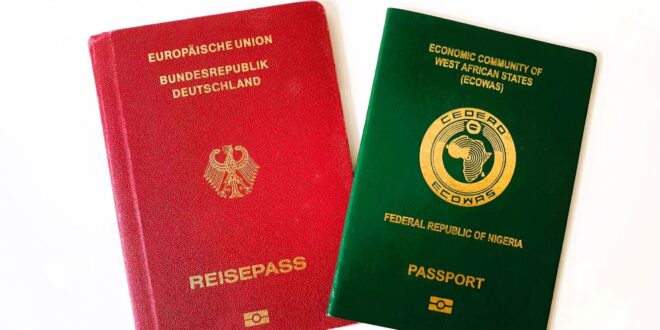
Germany granted citizenship to a record 332,500 foreign nationals in 2025, underscoring the growing importance of naturalisation as a pathway to full participation in German society. According to provisional figures released by the Federal Statistical Office (Destatis), the number of naturalisations rose by 14 per cent compared with 2024, marking the fifth consecutive annual increase and the highest figure since records began in 2000.
Syrians remained the largest single group among new citizens, accounting for one in five of all naturalisations at 65,600 — though that figure represents a 21 percent decline from the 83,200 Syrians who were naturalised the year before.
In contrast, the numbers for Turkish and Russian nationals rose sharply, each by 51 percent. Turkish citizens accounted for 34,100 naturalisations and Russians for 19,700, with analysts linking the surge to the June 2024 reform of citizenship law that now permits all new citizens to retain their previous nationality without exemption.
The reform — passed by the then-governing coalition of SPD, Greens and FDP — has fundamentally changed naturalisation patterns. According to a survey by Mediendienst Integration, between 85 and 98 per cent of newly naturalised Germans chose to retain their original nationality where permitted by their countries of origin. The small minority who did not typically came from countries such as India, Ethiopia and Eritrea, where the home state does not permit dual nationality. Before the reform, only EU citizens and a limited number of nationalities were entitled to retain a foreign passport.
The average length of residence in Germany at the point of naturalisation was 12.4 years in 2025, up from 11.8 years in 2024. Syrian nationals, who tend to apply as soon as they meet the minimum residence threshold, averaged 7.9 years in the country. Turkish and Russian applicants showed far longer ties — 24.1 and 14.1 years on average respectively.
On the procedural side, 467,400 naturalisation applications were filed in 2025. Berlin led all cities with around 36,100 new applications, followed by Munich with approximately 17,800 — though Munich also held a backlog of over 40,200 unprocessed cases as of early May. Nationwide, some 371,100 procedures were concluded during the year, with 90 percent resulting in a grant of citizenship, 5 percent withdrawn by applicants and roughly 3 percent refused. Security vetting by the domestic intelligence services (Verfassungsschutz) produced findings in fewer than 1 percent of cases reviewed.
One notable counter-trend: the total number of new applications fell by around ten percent compared to 2024 to approximately 189,000, according to Mediendienst Integration. The reversal coincides with the abolition in late 2025 of the so-called Turbo-Einbürgerung — the fast-track three-year naturalisation pathway for demonstrably well-integrated applicants — by the current CDU/SPD coalition. Only 1,500 people were naturalised on that basis in 2025, down from 19,100 the year before.
Sola Jolaoso