 THE AFRICAN COURIER. Reporting Africa and its Diaspora! The African Courier is an international magazine published in Germany to report on Africa and the Diaspora African experience. The first issue of the bimonthly magazine appeared on the newsstands on 15 February 1998. The African Courier is a communication forum for European-African political, economic and cultural exchanges, and a voice for Africa in Europe.

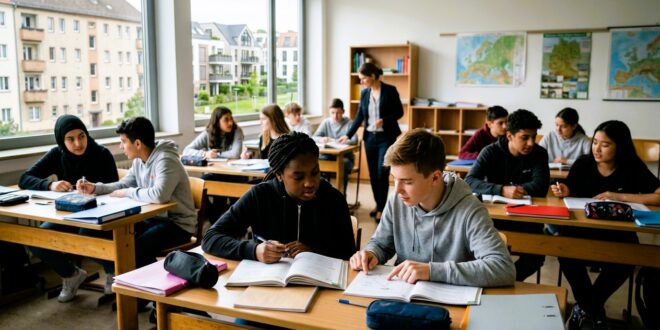
New results from the OECD’s PISA 2025 study, published this week, confirm a pattern that has followed German education policy for years: how well a child does in school in Germany still depends heavily on their family’s social background — and children with a migration history are disproportionately affected, since they are more likely to come from socially disadvantaged families in the first place.

What PISA 2025 found, in brief
PISA (the Programme for International Student Assessment) tested around 760,000 15-year-olds across 91 countries and economies in 2025, including roughly 6,700 students at some 250 schools in Germany. The results, released by the OECD on 8 September 2026, showed German students recording their lowest scores since PISA began: 486 points in science, 465 in reading and 464 in mathematics — only marginally above the OECD average in science, and essentially level with it in reading and maths. Roughly one in three German 15-year-olds now fails to meet the minimum competence level in reading and maths; in science, it is about one in four.
Education researchers, including PISA Germany study lead Samuel Greiff, have attributed the continued decline primarily to growing social inequality and a school system that struggles to compensate for the different starting points children bring with them, rather than to any single cause.
The core finding: social background matters more in Germany than elsewhere
PISA measures socioeconomic background through a combined index covering parents’ occupation, education and household resources. In Germany, this factor now explains 19 percent of the variation in students’ science performance — compared with an OECD average of just 12 percent, making Germany one of the countries where family background most strongly predicts school success.
The scale of the gap is stark: students from the most socioeconomically advantaged quarter of families scored, on average, 125 points higher in science than those from the most disadvantaged quarter — compared with an 85-point gap across the OECD on average. Worse, this gap has widened in Germany since 2015, even as it has narrowed across the OECD as a whole, driven mainly by falling scores among disadvantaged students while advantaged students’ scores held steady. Only about 2 in 100 socially disadvantaged students in Germany reach the highest competence levels, compared with roughly 25 in 100 among socially privileged students.
Pupils with a migration background: what the data shows
This is where the new results speak most directly to our readers. The OECD defines pupils with an immigrant background differently from the broader German statistical concept of Migrationshintergrund. For PISA, a pupil is classified as having an immigrant background if both parents were born outside the country in which the pupil is taking the test. The OECD distinguishes between first-generation pupils, who were themselves born abroad, and second-generation pupils, who were born in Germany but whose parents were born abroad.
The OECD finds that immigrant-background pupils are, on average, more likely to be socio-economically disadvantaged. Across the 29 OECD countries with comparable data, 41 per cent of immigrant-background pupils were in the disadvantaged quarter of the socio-economic scale, compared with 21 per cent of non-immigrant pupils.
The performance gap by migration background in the 2025 science results was substantial:
- Students without a migration background: 521 points on average
- Second-generation students (born in Germany, both parents born abroad): 463 points
- First-generation students who arrived in Germany before age 11: 423 points
- First-generation students who arrived at or after age 11: 392 points
Social background explains most, but not all, of the gap
Here is the finding most relevant to understanding what is actually going on — and it is the detail the original alert from Mediendienst Integration specifically highlighted: when researchers statistically account for socioeconomic background and the language spoken at home, the performance gap between students with and without a migration background shrinks considerably — but it does not disappear entirely.
In other words, the underlying story is less about migration itself and more about the fact that families with a migration history are, on average, more likely to be socioeconomically disadvantaged in Germany — and it is that disadvantage, more than migration status as such, that drives most of the gap in outcomes. A residual difference remains even after accounting for social background and language, pointing to other contributing factors that Mediendienst Integration and education researchers have flagged in separate analyses, including:
- A school system only partly adapted to multilingual classrooms — Germany’s schools have historically been slower than some other countries to build structured support for children who grow up speaking a language other than German at home.
- Experiences of discrimination, which some students report affecting their sense of belonging and engagement at school.
- Germany’s early tracking system, which sorts children into different secondary school types (commonly around age 10) — far earlier than in most other countries — potentially locking in disadvantage before it can be corrected. The gap between school types is enormous: at Gymnasien (academic-track schools), only 3 percent of students fail to meet minimum science competence; at non-Gymnasium schools, it is 37 percent.
Bias isn’t the main driver of track placement
A separate, more detailed 2026 study by the Leibniz Institute for Educational Trajectories — cited by Mediendienst Integration in its broader analysis of equal opportunity in German schools — adds an important nuance often missing from the debate.
Comparing children with similar social backgrounds, researchers found that children with a migration background do show somewhat lower measured competencies on average, but they are not graded more harshly by teachers, nor are they recommended less often for the academic Gymnasium track, than children without a migration background in the same social position.
In short: once social background is held constant, the school system does not appear to actively discriminate against these students in grading or track recommendations — even though outcomes still lag behind.
At the same time, there is a notable mismatch in self-perception: among students with a migration background who attend non-Gymnasium schools, 24 percent believe they belong on a higher academic track, compared with about 10 percent of students without a migration background in the same position — suggesting many students feel the system has placed them below where they believe they belong.
What this means for African families in Germany
For many readers, this is not an abstract statistic — it describes the system your children are navigating right now. A few practical takeaways:
- Social background, not migration status itself, is the strongest driver of the gap. This means targeted support addressing socioeconomic disadvantage — language support, resources, engagement with the school — can make a meaningful difference, rather than the gap being fixed or unavoidable.
- Track placement decisions matter enormously given how early Germany sorts children into different school types, and how large the outcome gap between tracks has become. Parents are encouraged to engage actively with teachers about track recommendations and to ask questions if they feel a recommendation does not reflect their child’s ability.
- Language support at home and school remains one of the more addressable factors. Since the language spoken at home is one of the two factors PISA explicitly measures alongside social background, maintaining strong support for German-language development — without necessarily abandoning home languages — remains a meaningful lever.
- You are not alone in raising these concerns. Organisations that track educational equity in Germany, including Mediendienst Integration, regularly publish accessible research summaries on this topic, which can help parents and students better understand and advocate within the system.
The latest PISA results tell a story that goes beyond migration. Pupils with an immigrant background are disproportionately affected by educational inequality – but the deeper problem is an education system in which social origin continues to exert such a powerful influence on educational success.
For further reading and the latest research on equal educational opportunity in Germany, readers can consult Mediendienst Integration’s dedicated overview at mediendienst-integration.de/bildung/schule/chancengleichheit-an-schulen/.
Femi Awoniyi
Sources: OECD, PISA 2025 Results; Mediendienst Integration; Bildung in Deutschland 2026. (OECD)