 THE AFRICAN COURIER. Reporting Africa and its Diaspora! The African Courier is an international magazine published in Germany to report on Africa and the Diaspora African experience. The first issue of the bimonthly magazine appeared on the newsstands on 15 February 1998. The African Courier is a communication forum for European-African political, economic and cultural exchanges, and a voice for Africa in Europe.

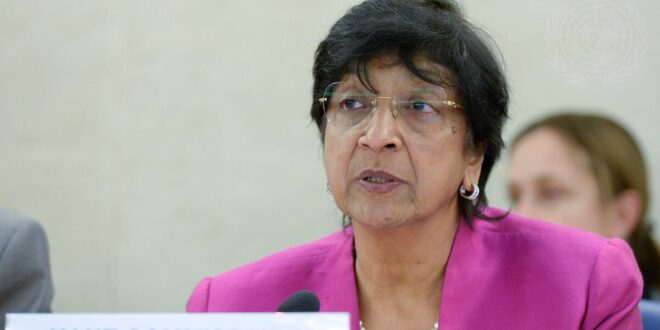
Former UN human rights chief honoured for her decades-long fight for justice and international law, joining a distinguished group of African Nobel laureates whose work has shaped the global struggle for human rights, democracy and peace.
South African jurist Navanethem “Navi” Pillay has been awarded the 2026 Nobel Peace Prize in recognition of her lifelong efforts to promote peace, uphold international law and strengthen accountability for war crimes, crimes against humanity and genocide.
The Norwegian Nobel Committee announced the award on 9 October, praising Pillay’s contribution to the development of international justice at a time when the global legal order faces mounting pressure.
Born in Durban in 1941 to a family of Indian Tamil descent, Pillay grew up under apartheid. Her experience of racial discrimination helped shape a legal career devoted to challenging injustice and defending fundamental rights.
In 1967, she became the first woman to establish a law practice in what was then South Africa’s Natal Province. She represented anti-apartheid activists and political prisoners, including Nelson Mandela’s fellow campaigners, at a time when the apartheid state systematically denied the majority population equal rights.
Following South Africa’s democratic transition, Pillay became the first Black woman appointed to the country’s High Court in 1995. She subsequently served on the International Criminal Tribunal for Rwanda, including four years as its president, and later became a judge at the International Criminal Court.
One of her most significant contributions came through the Rwanda tribunal’s landmark 1998 judgment in the Akayesu case. The ruling established that rape and sexual violence could constitute acts of genocide when committed with the necessary intent. It was a major development in recognising sexual violence as an instrument of mass atrocity.
From 2008 to 2014, Pillay served as the United Nations High Commissioner for Human Rights. She later chaired the UN Independent International Commission of Inquiry on the Occupied Palestinian Territory, including East Jerusalem, and Israel, from 2021 to 2025.
Established by the UN Human Rights Council in May 2021, the commission investigated alleged violations of international humanitarian law and international human rights law in the occupied Palestinian territory and Israel.
Its most consequential finding under Pillay’s leadership came on 16 September 2025, when the commission concluded that Israel had committed genocide against Palestinians in the Gaza Strip. After examining Israeli military operations and statements by political and military leaders from 7 October 2023 to 31 July 2025, it found that Israeli authorities and security forces had committed four of the five acts listed under the 1948 Genocide Convention: killing members of the group; causing serious bodily or mental harm; deliberately inflicting conditions of life calculated to bring about its physical destruction, in whole or in part; and imposing measures intended to prevent births.
The commission concluded that these acts were committed with the specific intent to destroy Palestinians in Gaza, in whole or in part. It also found that the State of Israel was responsible for committing genocide, failing to prevent it and failing to punish those responsible. Furthermore, it concluded that statements by Israeli President Isaac Herzog, Prime Minister Benjamin Netanyahu and then Defence Minister Yoav Gallant constituted incitement to genocide under the Convention.
The finding was the culmination of Pillay’s decades-long work in international justice and human rights. It also highlighted a central challenge confronting the international legal system: whether its principles can be applied consistently, including when allegations of grave crimes concern powerful states and their leaders.
The Nobel award therefore recognises not simply an individual career, but the principle that lasting peace depends on justice, legal accountability and the protection of human dignity.
A distinguished African tradition
Pillay becomes the latest African figure to receive the Peace Prize, joining laureates whose achievements span the anti-apartheid struggle, environmental protection, women’s rights and conflict resolution.
Among the most prominent are:
- Albert Luthuli (1960) – the South African anti-apartheid leader honoured for his non-violent struggle against racial discrimination.
- Anwar Sadat (1978) – Egypt’s president, who shared the prize with Israeli Prime Minister Menachem Begin for their contribution to the Middle East peace process.
- Desmond Tutu (1984) – the South African Anglican archbishop recognised for his role in the non-violent campaign against apartheid.
- Nelson Mandela and F.W. de Klerk (1993) – honoured jointly for their work towards the peaceful termination of apartheid and the foundations of democratic South Africa.
- Wangari Maathai (2004) – the Kenyan environmentalist recognised for sustainable development, democracy and peace.
- Ellen Johnson Sirleaf and Leymah Gbowee (2011) – two Liberian women honoured alongside Yemen’s Tawakkol Karman for their non-violent struggle for women’s safety and participation in peacebuilding.
- Denis Mukwege (2018) – the Congolese gynaecologist honoured for his efforts to end the use of sexual violence as a weapon of war
Pillay’s award adds another dimension to this legacy. While many previous African laureates were recognised for political leadership, reconciliation or grassroots activism, her distinction places the spotlight firmly on the institutions and legal principles intended to hold powerful individuals and states accountable.
For Africa, her recognition is also a reminder that the continent’s contribution to global peace extends beyond diplomacy and mediation: African jurists and human rights defenders have helped shape the international standards through which atrocities are judged.
Adira Kallo