 THE AFRICAN COURIER. Reporting Africa and its Diaspora! The African Courier is an international magazine published in Germany to report on Africa and the Diaspora African experience. The first issue of the bimonthly magazine appeared on the newsstands on 15 February 1998. The African Courier is a communication forum for European-African political, economic and cultural exchanges, and a voice for Africa in Europe.

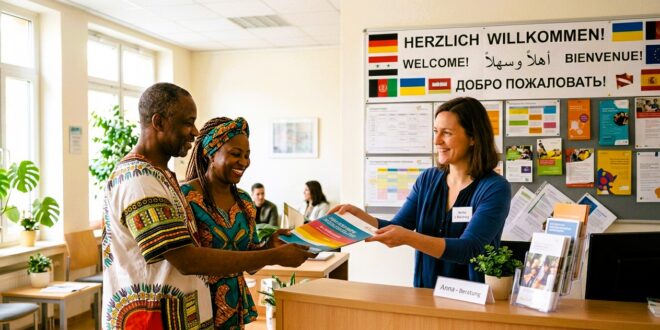
With voluntary access to Germany’s full Integrationskurse (integration courses) still largely closed to asylum-seekers and people with a Duldung (toleration permit) — even after the partial reopening from 1 August 2026 — Erstorientierungskurse (EOK, “first orientation courses”) remain, for now, the main structured option available to them. Here is what they are and how to access one.
What they are
EOKs are courses funded by the Federal Office for Migration and Refugees (BAMF), built around the concept “Erstorientierung und Deutsch lernen” (first orientation and learning German). They combine basic, practical German with everyday survival information — modules typically cover topics such as looking for work, shopping, healthcare, housing, schooling, and dealing with German authorities. The aim is to help people find their feet quickly after arrival, even before their asylum procedure or residence status is resolved.
Who can join
EOKs are aimed primarily at people seeking protection (Schutzsuchende) — including asylum-seekers and Duldung holders — who cannot yet access a regular integration course for legal, practical or individual reasons. Where places remain, recognised refugees and their families, other third-country nationals with lawful residence, and EU citizens may also join. The one condition that applies across the board: you must not currently have access to a full integration course.
Scope and structure
A typical EOK runs to around 300 teaching units (roughly three months full-time). Courses usually start with a short introductory unit (about 10 units) followed by longer follow-on modules (around 40 units each) that participants can join at different points, reflecting how often people move in and out of these courses. Compared to a full integration course (700 units, aiming for B1 German), an EOK gives a much more basic grounding — but it can normally be followed later by a full integration course if and when someone becomes eligible.
Cost
Participation is free for eligible participants. The courses are funded by BAMF, and from November 2026 increasingly through the EU’s Asylum, Migration and Integration Fund (AMIF), as part of a planned 60 percent expansion of the programme — backed by around €134 million in funding — through to 2029.
Where they happen
EOKs are run flexibly and locally. Many take place directly inside asylum accommodation centres (Gemeinschaftsunterkünfte), so that new arrivals can start almost immediately after arrival, while others are held at Volkshochschulen (adult education centres) or other local education providers. Availability and format therefore vary by city and region.
How to access one
Unlike a full integration course, EOKs generally do not require a formal BAMF Zulassung (admission approval) application. Instead:
- Ask staff at your accommodation centre or reception facility whether an EOK is already running on-site or nearby.
- Contact your local Volkshochschule or another adult education provider directly — in Berlin, for example, EOKs are coordinated through the Servicezentrum der Berliner Volkshochschulen; other cities have similar coordinating bodies.
- Ask your caseworker, social worker, or an advice service — including organisations such as YANA Berlin — to help you find the nearest course and confirm your eligibility.
- Check the BAMF website (bamf.de) for information on providers in your area, or ask your immigration office (Ausländerbehörde) if they can point you to one.
Because places are locally organised and can fill up quickly, it is worth asking early and, where possible, applying through more than one provider in your area.