 THE AFRICAN COURIER. Reporting Africa and its Diaspora! The African Courier is an international magazine published in Germany to report on Africa and the Diaspora African experience. The first issue of the bimonthly magazine appeared on the newsstands on 15 February 1998. The African Courier is a communication forum for European-African political, economic and cultural exchanges, and a voice for Africa in Europe.


In a judgment delivered on 11 June 2026, a Berlin court awarded financial compensation to a Black German man after finding that he had been subjected to racial discrimination during a police identity check. The ruling is seen as an important application of Berlin’s State Anti-Discrimination Act
_______
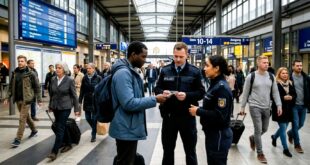
A Berlin court has ordered the state to pay €500 in compensation to a Black man after ruling that police officers gave undue weight to his skin colour during a 2023 identity check, a judgment rights advocates say underscores how persistent racial profiling remains in everyday policing, even as legal protections slowly take hold.
The case, decided by the Amtsgericht Berlin-Mitte (Berlin-Mitte Local Court), stemmed from an incident in January 2023 on the RAW-Gelände in Friedrichshain, an area police classify as “crime-affected.”
Officers had observed what they suspected was a drug sale involving three people and stopped two of them. On the ground nearby, they found a small vial containing a drug-like substance that they could not tie to anyone present. A third person at the scene got away, and officers later described him in court as “a dark-skinned man in a dark hooded jacket with a ‘Rasta hairstyle.’”
Still searching for the suspect, officers later stopped a different Black man, wearing a similar dark hoodie, but with short hair, at a nearby snack bar and asked for his ID. When he questioned why he was being singled out, the officers explained their reasoning; he pointed out that the description didn’t match him, but handed over his identification anyway. A subsequent database check by the officers turned up nothing.
The man then took the case to court, and largely won. Judges found it “predominantly probable” that officers had given skin colour a “dominant weight” in deciding whom to stop, in violation of Berlin’s State Anti-Discrimination Act (Landesantidiskriminierungsgesetz, LADG), in force since 2020. The court drew a line, however: while it found the officers’ database search to be unlawful discrimination, it judged the initial identity check itself not unlawful on its own. The ruling is not yet legally final as it still can be appealed, a court spokesperson said.
The judgment ordered the authorities to pay compensation, recognising that the claimant’s right to equal treatment had been violated. The decision is regarded as an important application of the LADG, which allows individuals to seek redress when they experience discrimination by public authorities.
For migrants and people of African descent, the case is a reminder that legal remedies exist when they believe they have been discriminated against by public authorities. Advocacy groups and Black community organisations in the capital have long argued that racial profiling at train stations, parks and other public spaces remains common, while official acknowledgement and redress have lagged behind.
Felix Dappah
READ ALSO Germany’s Anti-Discrimination Law Turns 20 Amid Calls for Stronger Protection