 THE AFRICAN COURIER. Reporting Africa and its Diaspora! The African Courier is an international magazine published in Germany to report on Africa and the Diaspora African experience. The first issue of the bimonthly magazine appeared on the newsstands on 15 February 1998. The African Courier is a communication forum for European-African political, economic and cultural exchanges, and a voice for Africa in Europe.

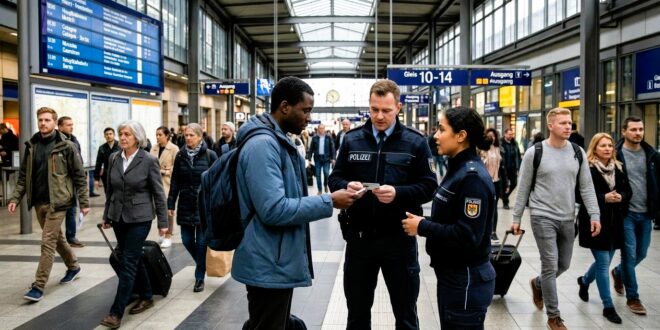
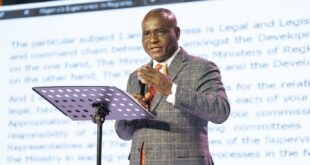
Germany’s independent Federal Police Commissioner, Uli Grötsch, this week presented his first annual report to Bundestag President Julia Klöckner — and the findings make for uncomfortable reading.
In the twelve months covered by the report, Grötsch, whose office was appointed by the Bundestag to oversee the work of the Federal Police, received 279 submissions from members of the public. The dominant theme was discrimination and racial profiling at border crossings, airports and railway stations, frequently accompanied by allegations of racism. Of those submissions, 50 — representing 12 percent of all complaints — concerned racial profiling specifically. In 19 cases, Grötsch opened a formal investigation. In ten, he found the conduct of the police officers concerned to be objectionable.
Racial profiling refers to the practice of stopping and checking individuals not on the basis of any specific suspicion, but solely on account of their physical appearance — their skin colour, or perceived ethnicity. It is a practice, prohibited under Germany’s Basic Law and anti-discrimination legislation, that Black and African communities across Germany have long complained about, and which the courts have repeatedly found to be unlawful.
In his report, Grötsch stressed that every complaint deserves careful investigation but also cautioned against drawing the conclusion that racial profiling is systemic within the Federal Police. At the same time, he called for continued efforts to strengthen public trust through transparency, better training and effective complaint mechanisms.
The issue of racial profiling has long been a source of debate in Germany. Human rights organisations, anti-racism groups and migrant organisations have repeatedly argued that people of African, Arab and other minority backgrounds are disproportionately subjected to identity checks, particularly at railway stations, airports and border areas. Several academic studies have found that members of ethnic minorities are significantly more likely than the general population to report being stopped by police without an apparent reason.
Police unions reject accusations of institutional racism, maintaining that officers conduct checks on the basis of operational intelligence and legal powers rather than ethnicity. They argue that officers working at transport hubs and border crossings often have to make rapid operational decisions under difficult circumstances.
The timing of the report is significant. It arrives at a moment of intensified border controls under Interior Minister Alexander Dobrindt, and just days after a Munich administrative court ruled that checks at the German-Austrian border were unlawful. The Munich ruling was triggered in part by a complaint from a Nigerian man who alleged he had been singled out on the basis of his skin colour.
Grötsch himself took a clear position on the government’s response: he described the decision to continue turning back asylum seekers at land borders, even after courts ruled the practice unlawful, as something he could not reconcile. He called on Dobrindt to find a solution that complies with European law, ideally in coordination with neighbouring countries.
The report is notable for another reason: this is the first time Germany has had such an office at all. The legal basis for the Police Commissioner’s role was created by the Bundestag in January 2024, serving as a contact point for both officers and members of the public to report misconduct or potential structural failings. Grötsch took up the position in March 2025.
For African and other diaspora communities in Germany, the existence of this office — and the willingness of its first occupant to name racial profiling as the single biggest source of public complaint — represents a meaningful, if modest, step forward. Whether the Federal Police and the Interior Ministry will act on the findings is another matter entirely.
Vivian Asamoah