 THE AFRICAN COURIER. Reporting Africa and its Diaspora! The African Courier is an international magazine published in Germany to report on Africa and the Diaspora African experience. The first issue of the bimonthly magazine appeared on the newsstands on 15 February 1998. The African Courier is a communication forum for European-African political, economic and cultural exchanges, and a voice for Africa in Europe.

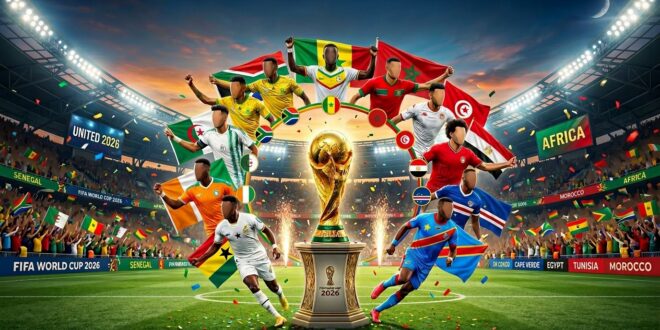
The 2026 FIFA World Cup, hosted jointly by the United States, Canada and Mexico, has already broken new ground for African football. For the first time, a record 10 African nations are competing in the tournament, raising hopes that the continent could finally produce a World Cup finalist – or even a champion.
The expanded 48-team format has allowed Africa to double its representation from five to ten teams. The continent’s flag bearers are Morocco, Senegal, Egypt, Ghana, Tunisia, Algeria, Côte d’Ivoire, DR Congo, South Africa and Cape Verde.
The biggest expectations rest on Morocco. The Atlas Lions captured the world’s imagination at the 2022 World Cup in Qatar by becoming the first African and Arab nation to reach the semi-finals. That historic achievement transformed perceptions of African football.
Morocco’s coach, Mohamed Ouahbi, recently dismissed the notion that his team are underdogs. “We want to compete with the best,” he said ahead of their opening match against Brazil. Analysts increasingly view Morocco as Africa’s strongest contender, thanks to a squad featuring internationally acclaimed players such as Achraf Hakimi and Yassine Bounou.
Senegal also enters the tournament with high expectations. Built around experienced stars and a solid defensive structure, the Teranga Lions have developed into one of Africa’s most consistent teams over recent years. Egypt, led by Liverpool icon Mohamed Salah, hopes to improve on previous World Cup disappointments and finally advance beyond the group stage for the first time since 1934.
| African Team | Nickname | Group | Group Opponents |
|---|---|---|---|
| 🇿🇦 South Africa | Bafana Bafana | Group A | Mexico, South Korea, Czechia |
| 🇲🇦 Morocco | Atlas Lions | Group C | Brazil, Scotland, Haiti |
| 🇨🇮 Côte d’Ivoire (Ivory Coast) | Elephants | Group E | Germany, Ecuador, Curaçao |
| 🇹🇳 Tunisia | Carthage Eagles | Group F | Netherlands, Japan, Sweden |
| 🇪🇬 Egypt | Pharaohs | Group G | Belgium, Iran, New Zealand |
| 🇨🇻 Cape Verde | Blue Sharks | Group H | Spain, Uruguay, Saudi Arabia |
| 🇸🇳 Senegal | Teranga Lions | Group I | France, Norway, Iraq |
| 🇩🇿 Algeria | Desert Foxes | Group J | Argentina, Austria, Jordan |
| 🇨🇩 DR Congo | Leopards | Group K | Portugal, Colombia, Uzbekistan |
| 🇬🇭 Ghana | Black Stars | Group L | England, Croatia, Panama |
Reigning African champions Côte d’Ivoire and traditional heavyweights Algeria and Ghana are also expected to be competitive. Meanwhile, debutants Cape Verde will aim to continue their remarkable football story on the global stage.
However, analysts caution that talent alone may not be enough. Issues such as inadequate preparation, administrative instability and limited resources have often undermined African teams at major tournaments. It has been noted for long by international analysts that governance challenges continue to hamper the continent’s ability to translate football potential into World Cup success.
Despite these obstacles, optimism remains high. Sports analysts interviewed by Nigerian media outlets believe Morocco, Senegal, Côte d’Ivoire and Egypt have realistic chances of reaching the knockout stages, with Morocco viewed by many as a potential dark horse for the latter stages of the competition.
For Africans worldwide, the tournament represents more than football. It is an opportunity to showcase the continent’s talent, resilience and growing influence on the global sporting stage. The success of African players in Europe’s top leagues has demonstrated the depth of talent available.
Thirty-six years after Cameroon became the first African nation to reach a World Cup quarter-final and four years after Morocco rewrote history in Qatar, the dream of seeing an African team contest a World Cup final no longer seems impossible.
As the 2026 tournament unfolds, millions across Africa and the diaspora will be watching with hope that this could finally be the year when African football takes its ultimate leap forward.
Adira Kallo