 THE AFRICAN COURIER. Reporting Africa and its Diaspora! The African Courier is an international magazine published in Germany to report on Africa and the Diaspora African experience. The first issue of the bimonthly magazine appeared on the newsstands on 15 February 1998. The African Courier is a communication forum for European-African political, economic and cultural exchanges, and a voice for Africa in Europe.

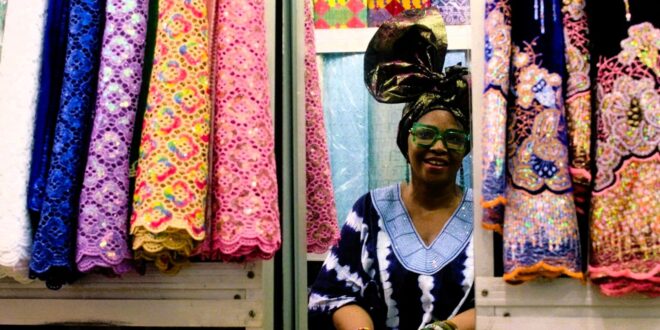
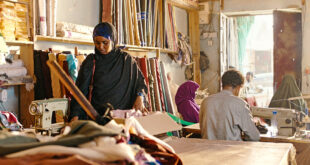
Lace Relations follows an expansive journey that begins in the bustling textile markets of Lagos, Nigeria, moves on to embroidery workshops in Lustenau, Austria, and reaches back to the historical roots of Europe’s prosperity. Centered on women, power dynamics and the global textile trade, the film exposes the colonial legacies that still influence Europe’s relationship with its neighbouring continent. Sarah Udoh-Grossfurthner* reviews the film
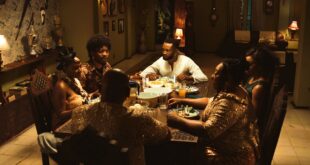
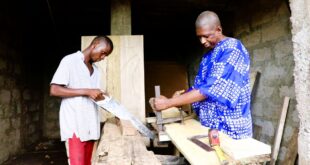
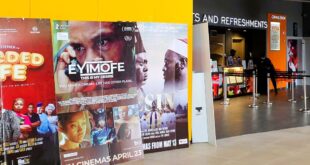
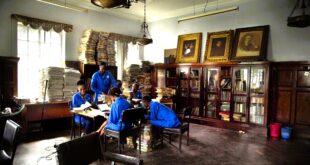
I sat in the cinema watching STOFF – Ein Spitzengeschäft (‘FABRIC – A High-Stakes Business’ or Lace Relations), and 88 minutes later, I walked out with more than emotion. I walked out carrying truths that had lain hidden in plain sight for years. This was not just a film; it was a reckoning, a remembering, a reclaiming and a retelling of a warped narrative hidden by those same years of obscurity.
The story begins in lace and the legacy of Alhaja Jarinat Yusuf Seriki, the celebrated queen of the lace trade in Gota. The name, Gota, itself is a distortion of the English word Gutter” and came from the 70s–90s reality of low-rise shacks and waterlogged gutters running through the area where her shop was located.
Yet from that very place, Alhaja Seriki, through sheer will-power and business-savviness, transformed what was dismissed as a slum into a textile powerhouse: a cash economy so vast it had to be seen to be believed. More importantly, she empowered women to become economic actors in their own right, not just because they were married to men who were.
So when I sat at Stadtkino in Vienna for the premiere of STOFF, I assumed the focus would rest on this powerhouse woman many Westerners might call “uneducated” simply because she could not read or write English properly or fluently. After all, Stoff means fabric in German, and she was the undisputed queen of textiles in Lagos in that era
But it did not end there.
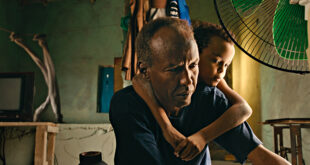
Through the lives of two protagonists Grete, and Ireti Bakare-Yusuf- activist, journalist and daughter of Alhaja Seriki (apple does not fall far, right?) the film draws us into the complex threads connecting Nigeria and Austria. It takes us to Lustenau in Voralberg, a region whose prosperity is deeply tied to the lace industry and its long trade relationship with Nigeria.
What looks like mere fabric story soon becomes history. What looks like commerce becomes legacy.
Then deeper layers surface: Austria’s entanglements with colonial systems, its discomfort with naming certain truths, and the silence around how much wealth flowed through these structures. During Nigeria’s textile import bans under Olusegun Obasanjo first administration (1976-1979), smuggling networks emerged, wealth accumulated, and other industries flourished. STOFF unravels this through firsthand accounts from people like Grete, who were inside those systems.
As an Austrian citizen with Nigerian roots, this story lives in me. Not because I lived those years, but because I am raising children rooted in both nations. As we say in Nigeria, “A child who does not know his past will remain confused about his future.” This film helps end that confusion. It restores memory, dignity and pride.
I want my children – proudly Austrian – to know that Nigeria’s role in Austria’s development is not marginal. Because identity built on truth stands strong and endures.
I am deeply grateful to the Austrian filmmakers and their Nigerian collaborators, including Chioma Onyeme, Joanna Adesuwa-Reiterer and, of course, Ireti Bakare-Yusuf, for telling this story. It needed to be told, to be unravelled and the many truths in it certainly needed to be revealed.
Still, STOFF is far too vast for one chapter. And I look forward to Parts 2, 3… even 4.
Yes! It’s that big a story.
—-
About the Author
Sarah Udoh-Grossfurthner is a Nigerian-born writer of poetry and prose whose work covers the highs and lows of the human heart. Her publications include BUT HE CALLS ME BLESSED: When the Unbelievable Happens to Believers; THE OLD WOMAN WHO REFUSED TO DIE; JUST AND ORDINARY GUY; PATHWAYS OF LIFE, as well as a feature in TIME magazine.
The author is also the creator of: From Fearful To Fierce, a memoir of a woman, who was abused, bullied and told she was worthless and would never amount to anything. Sarah holds a BA (Hons) in Diplomatic Studies and MA in Professional Writing from University College Falmouth, Cornwall.
More on Sarah Udoh-Grossfurthner:
Youtube: https://www.youtube.com/channel/UCK8JsMVi3Mr-yO9EmcdhpUQ
TikTok: http://www.tiktok.com/@fromfearfultofierce
LinkedIn: https://www.linkedin.com/in/sarah-udoh-grossfurthner-90623956/
Instagram: from_fearful_to_fierce
Spotify: https://open.spotify.com/show/3g7ZeqNSHx6rIsU2gDKMue
Linktree: https://linktr.ee/Sudohgrossfurthner