 THE AFRICAN COURIER. Reporting Africa and its Diaspora! The African Courier is an international magazine published in Germany to report on Africa and the Diaspora African experience. The first issue of the bimonthly magazine appeared on the newsstands on 15 February 1998. The African Courier is a communication forum for European-African political, economic and cultural exchanges, and a voice for Africa in Europe.


When Alain Gomis premiered DAO in competition at the Berlin International Film Festival, expectations were already high. The French-Senegalese director of Félicité has built a reputation for crafting emotionally rich, visually striking films and with DAO, he not only meets those expectations but surpasses them.
This France–Senegal–Guinea-Bissau co-production has already drawn critical acclaim, described as a “psychedelic African epic” (Die Welt), “thought-provoking and restlessly vibrant” (Screen Daily), and “magnificent” (Libération). These are not empty praises. DAO is indeed a bold, immersive work that lingers long after the credits roll.
At its core, the film tells a story that resonates deeply with Africans in the diaspora. It explores the lives of Africans and their descendants in Europe, France in this case, who find themselves suspended between cultures. Gomis does not treat this as a simple identity conflict; rather, he presents it as a complex, lived reality. His characters navigate multiple worlds simultaneously, embracing the richness of hybridity while confronting its tensions and emotional costs.
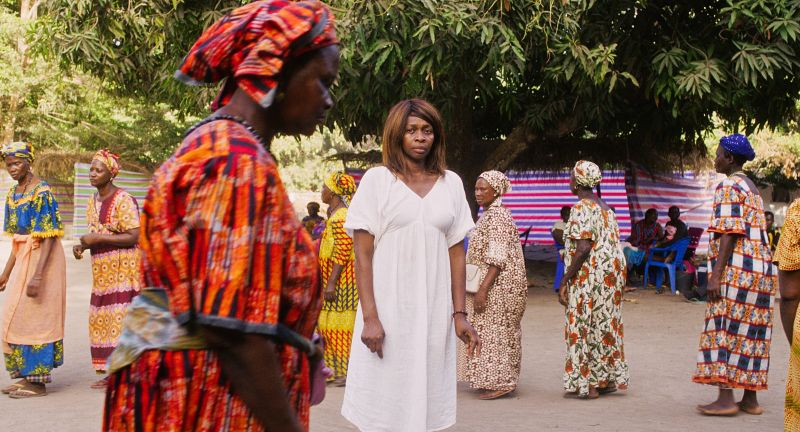
DAO draws on Taoist philosophy to portray life as a continuous, interconnected flow where opposites, such as life and death or migration and home, coexist in balance. Using both professional and non-professional actors, including members of the director’s family, the film is shaped through improvisation within an open structure, creating an immersive experience that conveys its ideas through feeling rather than explanation/Photo: Films That Matte
What makes DAO particularly compelling is its narrative method. The film blends fiction with elements drawn from real-life experiences, developed through a collaborative process involving both professional actors and non-professionals. This gives the story an authenticity that is difficult to manufacture. Conversations unfold at length, sometimes almost exhaustively, but this is precisely the point: the audience is not merely observing these lives but inhabiting them.
At nearly two hours, DAO demands patience from its audience and rewards it richly. The cinematography is nothing short of stunning, moving fluidly between intimate close-ups and expansive, almost dreamlike sequences that mirror the inner worlds of the characters. The visual language reinforces the film’s central themes of memory, displacement and belonging, creating a cinematic experience that is as sensory as it is intellectual.
Above all, DAO stands out for its emotional depth. It is a film that does not rush to conclusions or offer easy answers. Instead, it invites reflection — on family, history, migration and the enduring ties between Africa and its diaspora.
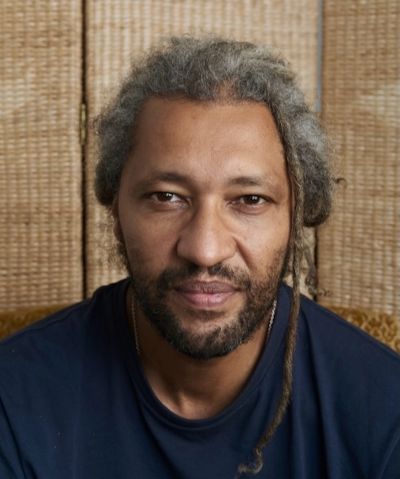
Alain Gomis, award-winning director of Félicité and Aujourd’hui. DAO is his sixth feature film, continuing a career marked by major international acclaim and a strong commitment to African cinema/Photo: Mabeye Deme
It is no exaggeration to say that DAO ranks among the most powerful films by an African or Afro-diasporic filmmaker in recent years. For me, it is one of the finest works to emerge from the continent and its global communities in a long time: intense, thoughtful and masterfully executed.
For African and Afro-diasporic audiences as well as anyone interested in the realities of Black life in Europe DAO is essential viewing. It is not just a film to watch, but one to experience.
The German cinema premiere takes place in Berlin on 27 May at 7 PM at the Haus der Kulturen der Welt, in the presence of the director, ahead of its nation-wide release on 4 June.
Femi Awoniyi

Editor’s Note
DAO will premiere in Germany at the Haus der Kulturen der Welt (House of the Cultures of the World), Berlin, on 27 May at 7:00 pm, in the presence of the director, Alain Gomis. The film will be screened in the original French version with English subtitles; the post-screening discussion will be held in French with simultaneous English translation.
More information about the event HERE
Cities and Cinemas where DAO will be screened
| City | Cinema |
| Aachen | Apollo Kino & Bar |
| Berlin | Sinema Transtopia |
| Berlin | Wolf Kino |
| Berlin | HKW |
| Berlin | fsk kino |
| Bochum | Casablanca |
| Bochum | Metropolis |
| Cologne (Köln) | Metropolis |
| Frankfurt / Main | Filmforum Höchst |
| Hamburg | Nestkino |
| Hamburg | Metropolis |
| Heidelberg | Karlstor Kino |
| Karsruhe | Kinemathek |
| Kiel | Studio Filmtheater |
| Leipzig | Passage Kinos |
| Munich | Werkstatt Kino |
| Nürnberg | Filmhaus Nürnberg |
| Oldenburg | Cine k |
| Regensburg | FilmGalerie-Kino im leeren Beutel |
| Würzburg | Central im Bürgerbräu |
More information HERE