 THE AFRICAN COURIER. Reporting Africa and its Diaspora! The African Courier is an international magazine published in Germany to report on Africa and the Diaspora African experience. The first issue of the bimonthly magazine appeared on the newsstands on 15 February 1998. The African Courier is a communication forum for European-African political, economic and cultural exchanges, and a voice for Africa in Europe.

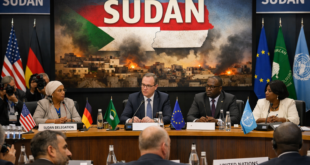
The Third International Sudan Conference in Berlin, co-hosted by Germany and the African Union, together with the European Union, France, the United Kingdom and the United States, mobilised historic levels of humanitarian funding and gave Sudanese civilian voices their biggest international platform yet. But with neither warring party present, a durable end to the world’s worst humanitarian crisis remains as elusive as ever.
By Adira Kallo, The African Courier
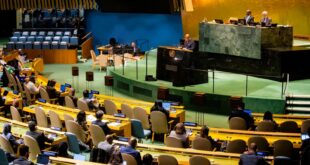
The German capital Berlin hosted the Third International Sudan Conference on 15 April — the third anniversary of the war’s outbreak — with pledges of more than €1.5 billion ($1.77 billion) in humanitarian aid, making it the largest donor mobilisation for Sudan since the conflict began. The sum surpasses the roughly $1 billion raised at the equivalent conference in London in 2025 and comes as the United Nations warns that only 16 percent of Sudan’s required humanitarian funding for 2026 had been secured before the Berlin meeting.
The European Union and its member states collectively committed over €812 million, while Germany announced an additional bilateral contribution of €230 million. Co-hosts France, the United Kingdom, the United States and the African Union added further pledges. German Foreign Minister Johann Wadephul, who chaired the conference, described the outcome as a “positive sign” given the declining global appetite for humanitarian funding, saying the pledges showed that Sudan had not been forgotten.
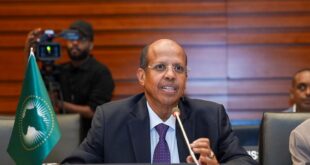
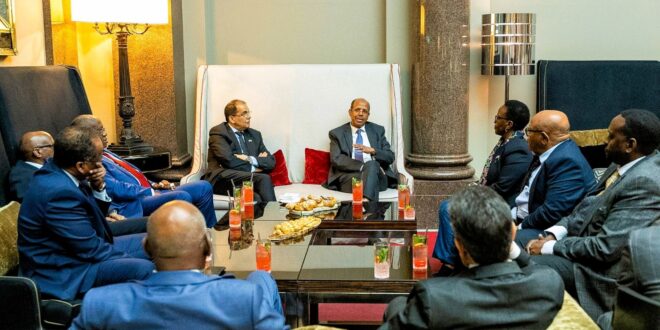
In his keynote address, the Chairperson of the African Union (AU) Commission, Dr Mahmoud Ali Youssouf, had underscored the urgent need for an immediate ceasefire as the first step towards ending the immense suffering of the Sudanese people. He called for stronger coherence among international mediation efforts, noting that fragmented initiatives risk undermining progress.
Emphasising the AU’s catalytic role, he urged partners to align behind a unified approach that supports a Sudanese-led and Sudanese-owned political process, inclusive of civilian actors.
The Chairperson also appealed for sustained humanitarian support and renewed global attention to the crisis, stressing that only coordinated action can pave the way for lasting peace and stability in Sudan.
A Civilian Track — and Its Limits
The conference introduced a formal civilian track for the first time in this series of international gatherings — convening around 40 representatives of Sudanese political and civil society groups to discuss the conditions for an eventual intra-Sudanese political dialogue. The track was facilitated under the Quintet framework, bringing together the African Union, the United Nations, the European Union, IGAD and the Arab League. Participants issued an appeal covering seven priorities: an immediate ceasefire, humanitarian access, protection of civilians, Sudan’s territorial unity, a Sudanese-led political dialogue, and accountability for wartime abuses.
But the civilian track generated as much controversy as consensus. Neither Sudan’s military government nor the Rapid Support Forces attended — the conference was deliberately designed to exert pressure on both parties rather than engage them directly. Sudan’s Prime Minister Kamil Idris publicly criticised the exclusion of his government, saying Khartoum would not consider itself bound by the conference’s outcomes. Several Sudanese civil society coalitions also boycotted the event, arguing that the invitation list was too narrow and that grassroots voices from displacement camps and besieged communities were effectively shut out.
The Diaspora Dimension
For the Sudanese diaspora — tens of thousands of whom are based in Germany and across Europe — Berlin carried particular weight. Diaspora networks have been among the most consistent funders of emergency relief inside Sudan, channelling remittances at a pace and scale that formal aid systems have repeatedly failed to match in active conflict zones. Civil society groups attending the conference’s parallel events specifically called for diaspora representatives to be formally included in future mediation processes, not merely as spectators but as participants with a seat at the political table.
READ ALSO Berlin Hosts International Conference on Sudan War
The humanitarian scale of what Berlin was responding to bears repeating. Three years of war between the Sudanese Armed Forces and the RSF have displaced around 13 million people inside Sudan and pushed a further 3.5 million across international borders — generating Africa’s largest displacement crisis and the world’s largest food insecurity emergency, with the UN estimating some 21 million people in acute hunger. Poverty has roughly doubled, to around 70 percent of the population, according to UNDP data.
The money pledged in Berlin will not end the war. But it may reduce the suffering of the people while diplomats and the warring parties — separately, and with painful slowness — work towards the ceasefire that a political settlement will ultimately require. For a conflict that has too often been described as forgotten, the fact that three successive annual conferences have now taken place, with funding rising at each iteration, is at minimum a sign that international attention has not entirely lapsed.
READ ALSO Editorial: What the Berlin Conference Must Deliver for Sudan