 THE AFRICAN COURIER. Reporting Africa and its Diaspora! The African Courier is an international magazine published in Germany to report on Africa and the Diaspora African experience. The first issue of the bimonthly magazine appeared on the newsstands on 15 February 1998. The African Courier is a communication forum for European-African political, economic and cultural exchanges, and a voice for Africa in Europe.

– SPECIAL REPORT –
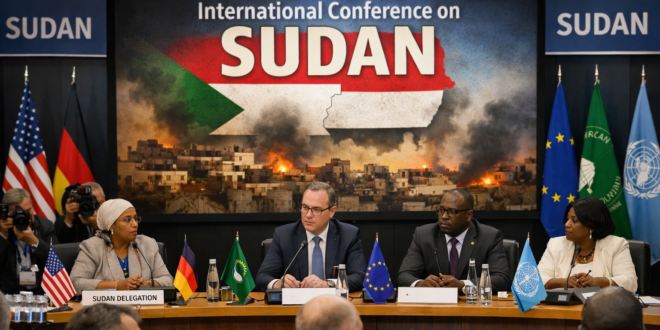
Three years after the guns first sounded in Khartoum on the morning of 15 April 2023, the Sudanese people remain trapped in what the United Nations has declared the world’s worst humanitarian crisis. On its anniversary on 15 April 2026, the German capital is playing host to the third International Ministerial Conference on Sudan — an event that its organisers hope will shift the trajectory of a war that has so far defied every international effort to end it.
Germany and the African Union, together with the European Union, France, the United Kingdom and the United States, are co-hosting the conference. Foreign ministers from those countries are expected in Berlin alongside representatives of the UN, major humanitarian organisations, and, for the first time, a formal civilian forum involving organised Sudanese civil society groups. The conference follows predecessor gatherings in Paris in April 2024 and London in April 2025, neither of which produced a durable ceasefire or a credible political framework.
For Sudanese diaspora communities in Germany and across Europe — many of whom have families directly caught up in the fighting — the Berlin conference is both a source of guarded hope and a test of whether the world’s leading governments are finally prepared to match their rhetoric with action.
BACKGROUND: A WAR THAT CHANGED EVERYTHING
The conflict erupted from a power struggle between two forces that had jointly conducted the coup of October 2021: the Sudanese Armed Forces (SAF), led by General Abdel Fattah al-Burhan, and the paramilitary Rapid Support Forces (RSF), commanded by General Mohamed Hamdan Dagolo, widely known as ‘Hemedti’. Fighting that began in Khartoum spread rapidly to Darfur, Kordofan and other regions, devastating infrastructure and fracturing state institutions that had already been badly weakened by decades of misrule.
By the beginning of 2026, the SAF had retaken the capital Khartoum and a number of other cities in central Sudan. However, the RSF retained control of much of Darfur and parts of Kordofan, and in October 2025 captured El Fasher — North Darfur’s capital, which had held out against an 18-month siege. Human rights organisations documented mass killings, widespread sexual violence and deliberate destruction of civilian infrastructure in and around El Fasher. A UN Fact-Finding Mission concluded that the RSF’s campaign bore ‘hallmarks of genocide.’
Both sides have faced serious allegations of violating international humanitarian law. The SAF has carried out indiscriminate airstrikes in South Darfur and other areas, bombing markets, residential neighbourhoods and health facilities. The UN Fact-Finding Mission found that both the SAF and the RSF have committed acts that may amount to war crimes.
THE CONFERENCE: ARCHITECTURE AND AMBITIONS
The Berlin conference is the most structurally ambitious of the three annual Sudan ministerials to date. While the Paris and London gatherings focused primarily on humanitarian pledges and political declarations, the Berlin edition introduces a third formal track: a civilian component dedicated to engaging organised Sudanese civil society in the peace process.
The conference operates across three tracks. The humanitarian track will address the catastrophic access and funding situation, with donors pressed to make and fulfil pledges far beyond the roughly 30 per cent delivery rate that characterised prior commitments. The political track brings together foreign ministers from the co-hosting nations and representatives of the two key international mediation architectures — the ‘Quad’ (the United States, Saudi Arabia, Egypt and the United Arab Emirates) and the ‘Quintet’ (the United Nations, the African Union, the League of Arab States, the Intergovernmental Authority on Development, and the European Union). The civilian track, a new feature, brings together Sudanese political blocs, civil society organisations, and independent figures.
Preparatory meetings take place in Addis Ababa from 10 to 12 April, sponsored by the Quintet, with the aim of forming a Sudanese steering committee that could set the agenda and criteria for a credible political process. The Stiftung Wissenschaft und Politik (SWP), Germany’s leading foreign and security policy think tank, argued that the conference offers ‘a long-overdue change in perspective: away from the warring parties and towards those who are already working for societal and political peace.’
THE CIVILIAN TRACK: A NEW OPENING — AND ITS LIMITS
The inclusion of a civilian track at the Berlin conference is widely seen by peace advocates as the most significant procedural innovation in international efforts to resolve the Sudanese crisis. The Sudanese Civilian Convergence Tracks Initiative (SCCT), an umbrella body representing a range of civil society groupings, has developed a ‘civilian theory of change’ — a roadmap for how organised Sudanese civilian voices can contribute to both a humanitarian ceasefire and a durable political settlement.
Advocacy organisations including the Heinrich Böll Foundation, Amnesty International and the Friedrich Ebert Foundation will hold a parallel panel event in Berlin on 13 April, featuring Sudanese civil society voices including Ahmed Eltom of the Youth Citizens Observers Network and Asma Elnaiem of the Advocacy Group for Peace in Sudan. The even will focus on civilian inclusion in peace negotiations, humanitarian ceasefire arrangements, the alignment of political and civilian tracks, and a civilian roadmap for sustainable peace.
However, the civilian track has already generated controversy before the conference even convened. The Sudanese National Forces Alliance announced a categorical boycott in late March 2026, citing the exclusion of the Sudanese government from the main conference and what it described as ‘artificial’ civilian representation dominated by factions aligned with the RSF and the parallel ‘Taasis’ administration — a quasi-governmental structure formed by the RSF and its allies in territories under their control. The Alliance argued that small, externally sponsored entities had been granted greater representation than major Sudanese political constituencies.
Analysts at the Sudan Horizon have reported that only around 40 individuals representing political blocs, parties, civil society organisations and independent figures were invited to the civilian track — and that a majority were affiliated with the ‘Sumoud’ and ‘Taasis’ coalitions, with only limited seats allocated to the Democratic Bloc. Critics questioned whether the conference was producing a genuinely inclusive civilian process or simply lending international legitimacy to the political allies of one of the armed parties.
INTERNATIONAL MEDIATION: FRAGMENTED EFFORTS, SHARED FAILURE
One of the defining features of the Sudan crisis has been the fragmentation of international mediation, say analysts. Two competing multilateral architectures — the Quad and the Quintet — have pursued broadly parallel processes without achieving the alignment needed to produce a ceasefire. Within both structures, members have pursued divergent national interests, with the UAE in particular reported to have backed the RSF through weapons transfers despite the UN Security Council arms embargo on Darfur.
At the London conference in April 2025, the UAE — reportedly with American backing at the time — pushed an agenda critical of the SAF, while Egypt and Saudi Arabia pushed back in favour of language preserving Sudanese state institutions. The result was a failure to agree on a unified final statement — a diplomatic outcome that signalled the depth of the divisions within the mediation architecture.
A degree of renewed unity among the Quintet organisations was visible in early 2026, following joint consultations with Sudanese civilian and political groups. The SWP noted that ‘in contrast to earlier approaches, there is currently greater unity among the participating organisations as well as a coordinated process design.’ However, a genuinely convergent political will — particularly involving the Quad members — remains elusive.
Switzerland has separately been hosting confidential talks between Sudanese civilian parties since July 2023 as part of its good offices mandate. A peace conference organised at the initiative of the United States in Switzerland in August 2024 was unable to progress to ceasefire talks when one of the parties to the conflict declined to attend. A further conference in Brussels took place on 26 March 2026, immediately preceding the Berlin ministerial.
For the Sudanese government and the SAF, the exclusion of Khartoum from the main conference proceedings has been a source of deep grievance. Analysts at Sudan Horizon argued that the Sudanese authorities must recognise ‘the scale of international alignments and pressures’ and work to open humanitarian corridors and engage with relief organisations — or risk the international community effectively imposing its own political framework regardless of Khartoum’s preferences.
AFRICA’S ROLE: THE AFRICAN UNION AND THE BERLIN CONFERENCE
The co-hosting role of the African Union gives the Berlin conference a legitimacy that its predecessors in Paris and London — both European-led — arguably lacked. The AU’s involvement also reflects the continental dimension of the crisis: Sudan’s conflict has destabilised an arc of neighbouring states, with Chad, South Sudan, Ethiopia, Uganda and Egypt all hosting large refugee populations and, in some cases, parties to the conflict with interests in its outcome.
Germany’s Foreign Minister Johann Wadephul visited the AU headquarters in Addis Ababa in January 2026 as part of his first official trip to Sub-Saharan Africa since taking office, where he reaffirmed the joint commitment to hosting the Berlin conference and discussed the implementation of the Pretoria Agreement — a reference to regional peace processes in which the AU has played a central facilitation role.
Countries hosting Sudanese refugees — Chad, South Sudan, Ethiopia and Uganda — have been invited to join the main conference group in Berlin, a recognition that the humanitarian and political consequences of the war extend far beyond Sudan’s borders. The UN issued an appeal for $1.6 billion in February 2026 specifically to support refugees across the region; those funds had barely begun to materialise by the time the conference opened.
CIVILIAN PROTECTION AND ACCOUNTABILITY: THE DEMANDS OF CIVIL SOCIETY
In an open letter to European Commission President Ursula von der Leyen published in the run-up to the Berlin conference, a coalition of human rights organisations called on the EU and its member states to seize the ministerial as an opportunity to respond to ‘serious, ongoing human rights violations’ and to hold perpetrators to account. The letter cited the UN Fact-Finding Mission of February 2026, which documented serious and massive violations against civilians and identified ‘hallmarks of genocide’ in El Fasher.
Amnesty International called on participating governments to commit increased funding to frontline NGOs and to pressure warring parties to ensure unhindered humanitarian access — specifically including services for survivors of sexual violence. ‘The Berlin meeting must not be another talking shop,’ said Tigere Chagutah, Amnesty International’s Regional Director for Eastern and Southern Africa.
A coalition of international NGOs issued a joint statement welcoming the announcement by the Sudan Core Group at the UN Human Rights Council in February 2026 of a new coalition to prevent further atrocities in Sudan. The statement called on the UK and other co-hosts to ‘bring meaningful collective prioritisation to the distinct need to protect civilians and prevent further atrocities’ and urged that ‘Sudanese civil society and the voices of survivors must be at the heart of discussions in Berlin and the work of the Coalition, not consulted on the margins.’
The ICC’s conviction in October 2025 of former Janjaweed militia leader Ali Kosheib for war crimes and crimes against humanity in Darfur — the first such conviction arising from the court’s two-decade Darfur investigation — was welcomed as a signal that accountability remains possible. However, human rights organisations noted that the ICC’s mandate is limited to Darfur, leaving no independent judicial mechanism to investigate crimes committed across the rest of Sudan.
CONCLUSION: THREE YEARS, THREE CONFERENCES, ONE CHANCE
The Sudan war has produced more displaced people than any other conflict on earth. It has killed tens of thousands, shattered one of Africa’s most historically significant cities, and pushed a country that was already fragile to the edge of state collapse.
Three annual ministerial conferences have not ended it. But the Berlin conference is different in at least two respects: it is the first to formally incorporate a civilian track, and it is the first to be co-hosted by the African Union rather than by European states alone. Those differences matter — not because they guarantee success, but because they create conditions for a more legitimate and more durable process than anything that has come before.
The test of Berlin will not be what is announced on 15 April. It will be what is still happening in October — whether aid has reached the people of Zamzam and Kadugli, whether the civilian steering committee is functioning, whether pledges have been honoured, and whether the guns are any closer to falling silent. For thirty-three million people in need of assistance, for thirteen million displaced, for a diaspora spread across Europe and beyond: the world must get this right.
© AfricanCourierMedia
Editorial: What the Berlin Conference Must Deliver for Sudan