 THE AFRICAN COURIER. Reporting Africa and its Diaspora! The African Courier is an international magazine published in Germany to report on Africa and the Diaspora African experience. The first issue of the bimonthly magazine appeared on the newsstands on 15 February 1998. The African Courier is a communication forum for European-African political, economic and cultural exchanges, and a voice for Africa in Europe.
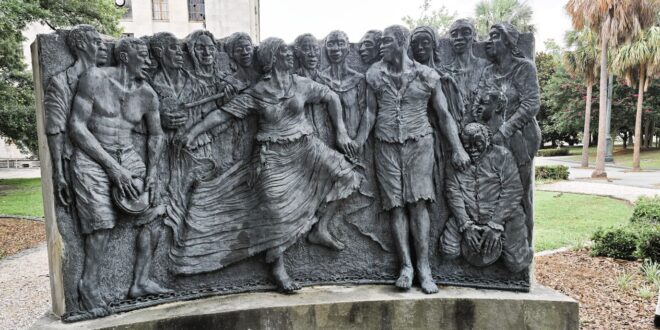
When Berlin-based freelance journalist Wolfgang König recently travelled to New Orleans, he found himself drawn not only to the city’s famous music clubs and historic streets, but to a modest open space whose global significance is easy to overlook. In this reflection, König traces the remarkable history of Congo Square — a place where African traditions survived enslavement, shaped the cultural identity of New Orleans, and laid the foundations for much of today’s global popular music

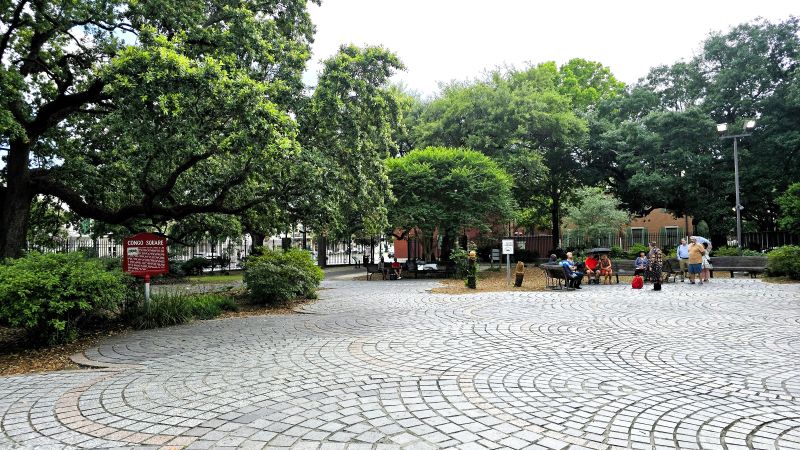
If you start from Old Man River and cross the French Quarter, the historic old town of New Orleans, you’ll reach a park dedicated to the city’s most famous son: Louis Armstrong. Look to the left, and you’ll see an empty space. It looks unimpressive at first sight. And yet, without this place — named Congo Square — the cultural history of the USA, and indeed of the whole world, would have followed a different path. Blues, jazz, funk, soul and hip hop: without Congo Square, global popular music over the last 120 years would not exist as we know it. Here, African cultural heritage was preserved and developed more than anywhere else in North America.

Just one year after Jean-Baptiste Bienville founded New Orleans on the lower reaches of the Mississippi in 1718, two ships brought 451 enslaved Africans to the city. Ever since, people of colour have made up the majority of its population.
Six years later, the Code Noir of the French colony of Louisiana, in which New Orleans was the biggest settlement, declared Sunday a day off for everyone, slaves included. Things stayed that way during the three decades of Spanish rule, from 1766 on and even after Napoleon had sold the whole Louisiana territory (which was much bigger than the present-day US state of the same name) to Washington, D.C. in 1803. The enslaved population was assigned a place beyond the then city limits, which eventually became known as Congo Square. Native Americans had gathered there before, but this, of course, did not concern the colonial authorities.
Henry Knight, who visited the city in 1817, noted that each Sunday hundreds of enslaved people and free Blacks gathered on the square, “rocking the city with their Congo dances” — although his knowledge was certainly insufficient to accurately locate the origins of these dances in the Congo Basin. Two years later, the municipal civil engineer Benjamin Latrobe observed that “the allowed amusements of Sunday have, it seems, perpetuated here those of Africa among its inhabitants.”
The historian Freddi Williams Evans writes in her profoundly researched book Congo Square – African Roots in New Orleans, that although Latrobe considered “what he heard and saw to be highly distasteful, he captured the essence and most significant aspect of the affair — the perpetuation of African cultural traditions found in the regions of Africa from which the gatherers originated. In Congo Square on Sunday afternoons, African descendants spoke and sang in their native languages, practiced their religious beliefs, danced according to their traditions and played African-derived rhythmic patterns on instruments modeled after African prototypes. This African population also bought and sold goods that they made, gathered, hunted and cultivated much in the style of West African marketplaces”. A cannon shot in the evening signalled the end of the event.
During the week, the square served other purposes. It was used, for example, for circus performances and, until 1829, even for slave auctions: after all, New Orleans was the largest slave market north of Havana. Located near the Caribbean coast, the city had particularly close ties — during French and later Spanish colonial rule — to St. Domingue (today’s Haiti) and Cuba. After the successful slave rebellion in St. Domingue, many French settlers fled to New Orleans with some of their enslaved people, while many free Blacks who had collaborated with the French also sought refuge there. This influx increased the number of people gathering at Congo Square each Sunday. With them came Afro-Caribbean Vodoo, including its music.
In the Protestant regions of New England, Sunday was mainly reserved for church services and solemn rest. Music, dance and other activities that expressed the joy of life were considered reprehensible. Not least because of this tradition, enslaved people in those areas lost a large part of their African cultural heritage. This was not the case in Louisiana, which, owing to its French and Spanish past, was predominantly Catholic. After Sunday services, it was common to enjoy cockfights, ball games, circus and theatre performances — and, in Congo Square, music and dances of African origin. Participants had been born in North America, Haiti, Cuba and Africa. Their different cultural traditions merged in the melting pot of New Orleans, with influences from Europe and even from indigenous peoples — since, from time to time, Native Americans could also be seen in Congo Square as well.
It is no exaggeration to call the gatherings at Congo Square the city’s first tourist attraction. They attracted the attention of a white audience, including many artists, often travelling performers, who drew inspiration from what they saw and heard. They went on to spread these cultural elements through their own shows — across the country, as far as Broadway in New York, and even to Europe. Louis Moreau Gottschalk (1829–69), the first significant composer from New Orleans, who grew up near Congo Square, was demonstrably influenced by the music he heard there each Sunday.
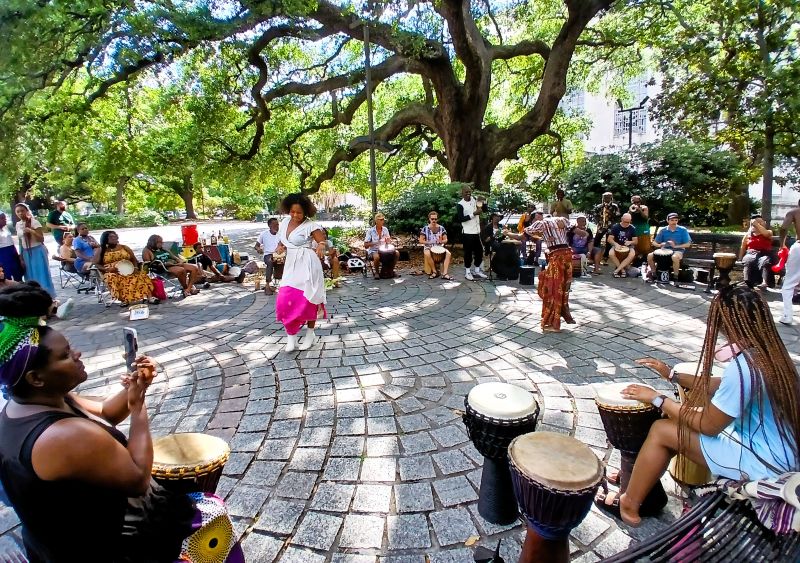
If you happen to be in New Orleans on a Sunday afternoon, a visit to Congo Square — a place so vital to today’s global popular culture — is an absolute must. You will see people playing drums and horns, many dancers and others who just enjoy experiencing the living tradition, still beloved by locals, of “rocking the city with their Congo dances”.