 THE AFRICAN COURIER. Reporting Africa and its Diaspora! The African Courier is an international magazine published in Germany to report on Africa and the Diaspora African experience. The first issue of the bimonthly magazine appeared on the newsstands on 15 February 1998. The African Courier is a communication forum for European-African political, economic and cultural exchanges, and a voice for Africa in Europe.
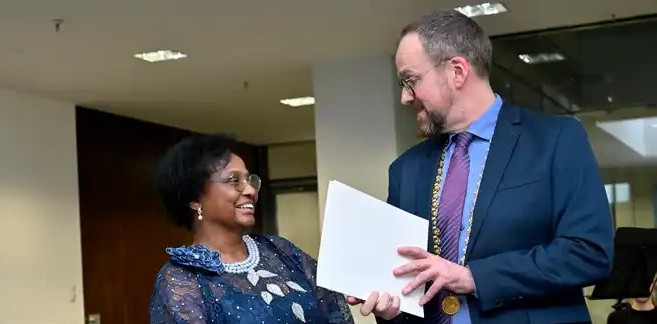
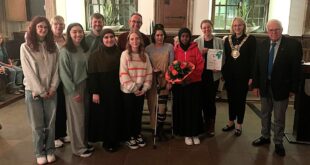
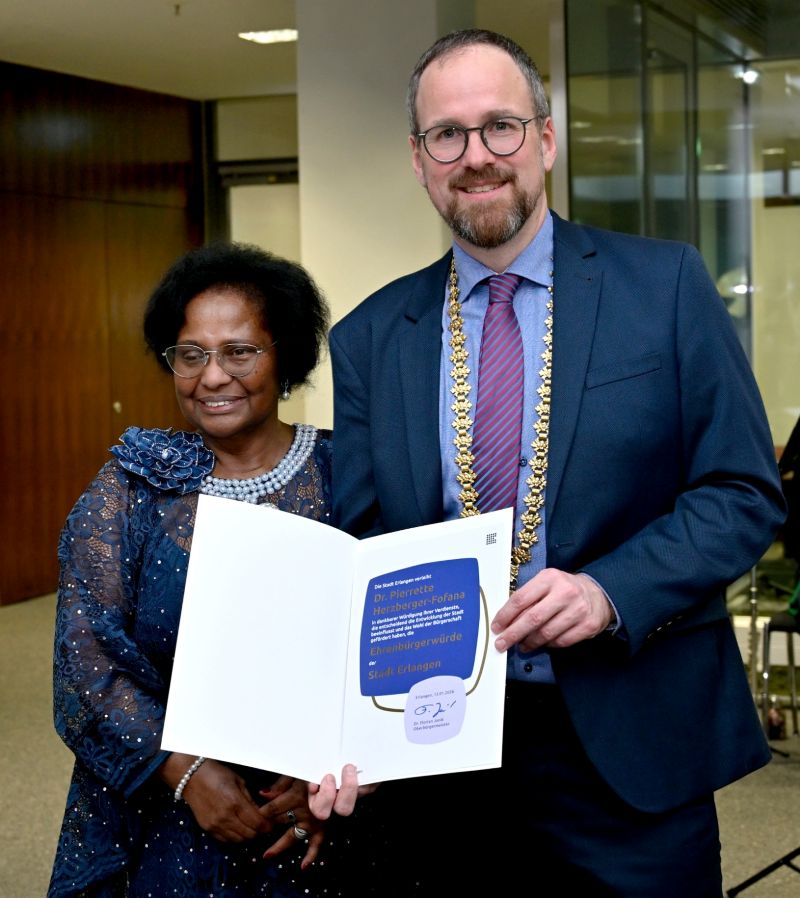
When the City of Erlangen formally honoured Dr Pierrette Herzberger-Fofana at a solemn ceremony on 13 January 2026, it was more than a celebratory moment. Held at Erlangen City Hall during a special session of the City Council, the occasion marked the recognition of a life dedicated to social justice, civic engagement and the long, often difficult struggle for equality and dignity – locally, nationally and internationally.
By being named an Honorary Citizen of Erlangen, Dr Herzberger-Fofana entered a very exclusive circle. Since 1822, the title has been awarded to only a handful of individuals. She is only the second woman in the city’s history to receive the honour and the first woman of African descent, a milestone that carries symbolic weight far beyond Erlangen.
Since 1822 – over 200 years – the city’s highest distinction has been awarded to only 53 men and two women. In accordance with municipal statutes, only five living persons may hold the title of Honorary Citizen at the same time.
From West Africa to Franconia
Born in Mali and raised in Senegal, Pierrette Herzberger-Fofana’s journey to Germany was shaped by education and intellectual curiosity. She studied in Paris, Munich and Trier before settling in Erlangen, where she built an academic career in literary studies at the University of Erlangen–Nuremberg. What began as an academic path soon evolved into a broader commitment to public life.
Her connection to Erlangen deepened over the years, not only through her professional work but also through her growing engagement with the city’s social realities. In 1996, she made a bold move by running for mayor with the slogan “We bring colour into this tournament”—a message that reflected both her personality and her vision of an inclusive city.
Shaping local politics and social cohesion
From 2005 to 2019, Dr Herzberger-Fofana served as a member of the Erlangen City Council, where she focused on education, social affairs, health, youth policy and human rights. Her work was driven by the belief that cities are not just administrative units but living communities whose strength lies in cohesion and mutual respect.
One of her most lasting local legacies is the launch of the Black History Weeks in 2015, initiated within the framework of the United Nations International Decade for People of African Descent. The annual series of events created space for dialogue, learning and visibility, bringing the history and present-day realities of Black people in Germany into the public consciousness.
It was in recognition of this sustained local impact that the Erlangen City Council unanimously decided on 2 May 2025 to confer on her the title of Honorary Citizen, the highest distinction awarded by the city.
A historic voice in Europe
Dr Herzberger-Fofana’s political journey reached a new level in 2019, when she became the first Afro-German woman elected to the European Parliament, representing Bavaria for Bündnis 90/Die Grünen. During her term from 2019 to 2024, she focused on global justice, sustainable development and human rights, consistently linking European policies to their impact on Africa and the Global South.
Her presence in the European Parliament carried symbolic significance for many people of African descent in Germany and across Europe – proof that political representation, though hard-won, is possible.
Championing women’s rights
Beyond elected office, Dr Herzberger-Fofana has been a tireless advocate for women and girls, particularly in the fight against female genital mutilation (FGM). As a co-founder of Forward-Germany – Foundation of Women’s Health Research and Development, she has worked for decades to raise awareness, influence policy and support affected communities.
In 2013, she addressed the United Nations in New York, reinforcing her belief that women’s rights are inseparable from human rights.
Recognition earned over decades
The honorary citizenship bestowed by Erlangen crowns a long list of recognitions. In 2009, the German government awarded her the Helene Weber Prize for her commitment to combating violence against women. Internationally, she has been honoured by the Republic of Senegal, which named her a Knight of the National Order of Merit, and Howard University in Washington, D.C., paid tribute to her.
For Dr Herzberger-Fofana, the honour from Erlangen holds particular meaning. It reflects, in her words, a city that does not merely speak about equality and diversity but actively works to make them a reality.
“Being here today means far more to me than a personal honour. It is a sign of trust from a city that not only values commitment, equality, diversity, and cohesion, but makes them a concrete reality. I sincerely thank the City of Erlangen and its people,” she said in her acceptance speech.
A legacy that resonates
Dr Pierrette Herzberger-Fofana’s story is one of perseverance, courage and bridge-building – between continents, cultures and generations. Her life’s work demonstrates how sustained civic engagement can reshape institutions and broaden the meaning of belonging.
For Africans and people of African descent in Germany, her journey stands as both inspiration and affirmation: that commitment to the common good can leave an indelible mark, and that recognition, though sometimes slow, can ultimately follow.
Vivian Asamoah