 THE AFRICAN COURIER. Reporting Africa and its Diaspora! The African Courier is an international magazine published in Germany to report on Africa and the Diaspora African experience. The first issue of the bimonthly magazine appeared on the newsstands on 15 February 1998. The African Courier is a communication forum for European-African political, economic and cultural exchanges, and a voice for Africa in Europe.
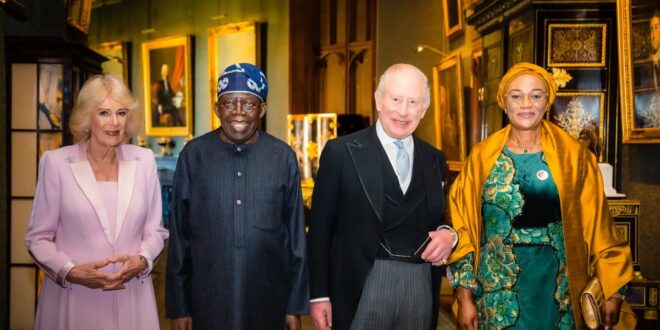
For the first time in 37 years, a Nigerian head of state has been received at Windsor Castle — and the visit has yielded concrete economic rewards, from a landmark ports financing deal to fresh commitments on trade, security and cultural exchange.
When President Bola Ahmed Tinubu and First Lady Oluremi Tinubu stepped out of a royal carriage at Windsor Castle on Wednesday 18 March, they made history. The pomp and pageantry — a ceremonial salute from the King’s Troop Royal Horse Artillery, the Nigerian national anthem echoing across Windsor Great Park, and an evening state banquet in St George’s Hall — marked the first state visit by a Nigerian president to the United Kingdom in 37 years.
The last was General Ibrahim Babangida’s four-day trip in 1989, when he met Queen Elizabeth II at the height of military rule. Nigeria has changed dramatically since then, and so, apparently, has the weight it commands on the world stage.
King Charles III set a celebratory tone from the outset, describing Nigeria as an “economic powerhouse” and declaring that the country “has not merely changed, it has arrived.” At the banquet — the first hosted during Ramadan for a Muslim head of state since 1928, with special arrangements including an iftar provision and a dedicated prayer room — Charles thanked Tinubu for travelling during the holy month, calling it “no small sacrifice.”
In his own address, Tinubu spoke of the deep institutional links between the two nations: shared common law traditions, parliamentary heritage, Commonwealth ties, and a Nigerian diaspora of about 300,000 UK residents who, he said, represent “the strongest bridge between our two countries.”
Beyond the pageantry of the state banquet, President Tinubu held high-level talks with Prime Minister Keir Starmer at Downing Street, where discussions focused on trade, investment, security cooperation and migration. The meeting underscored both countries’ intention to translate diplomatic goodwill into concrete economic outcomes, particularly through the implementation of the Enhanced Trade and Investment Partnership (ETIP). Starmer framed the meeting as an opportunity to take a relationship that already includes record bilateral trade of around $10.7 billion annually to “another level.”
For a country battling the painful aftershocks of far-reaching economic reform, the visit’s most tangible prize came in the form of a £746 million financing agreement signed between UK Export Finance (UKEF), the Nigerian Ports Authority and the Federal Ministry of Finance. The deal will fund the refurbishment of two critical maritime hubs — the Lagos Port Complex at Apapa Quays and the Tin Can Island Port Complex.
Modernised ports mean faster cargo throughput, lower logistics costs and greater competitiveness for Nigeria’s economy. In a country where port inefficiency has long adversely affected trade, the significance of this investment should not be underestimated.
Several Memoranda of Understanding were signed, spanning trade, investment, defence and cultural cooperation. Starmer also welcomed Nigerian companies expanding into the UK market, signalling a recognition of Nigeria not merely as a recipient of investment, but as a source of it.
Security was also on the agenda. Tinubu, whose domestic challenges include a persistent Boko Haram insurgency in Nigeria’s northeast and widespread banditry in its northwest, underscored the need for continued UK partnership in countering Sahel-region terrorism.
The visit was rounded out with cultural diplomacy: the President and First Lady were invited to view a special Royal Collection exhibition of Nigerian artefacts at Windsor Castle, and attended the Nigerian Modernism exhibition at Tate Modern, while also meeting members of the diaspora community in a reception that underlined just how intertwined the two nations’ lives have become.
That it took 37 years to reach this point says something about the uneven rhythms of diplomacy. That it has arrived now — with Nigeria pursuing bold economic reforms, with its diaspora more prominent than ever in British public life, and with both governments seeking new post-Brexit trade partnerships — suggests the timing is no accident. For ordinary Nigerians enduring tough economic times, the true measure of this visit will lie not in banquet speeches but in whether the port cranes turn, the investment flows and the agreements hold.
Kola Tella