 THE AFRICAN COURIER. Reporting Africa and its Diaspora! The African Courier is an international magazine published in Germany to report on Africa and the Diaspora African experience. The first issue of the bimonthly magazine appeared on the newsstands on 15 February 1998. The African Courier is a communication forum for European-African political, economic and cultural exchanges, and a voice for Africa in Europe.

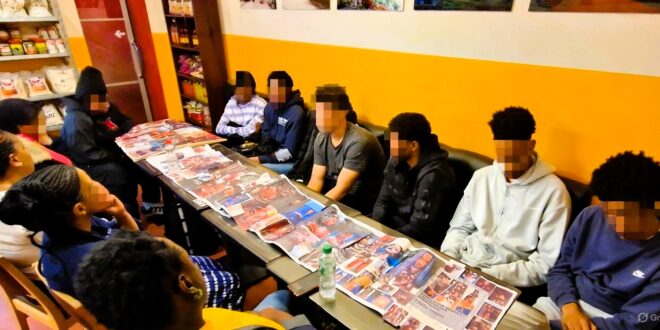
Institutional racism does not begin with open hostility or explicit exclusion. It often starts quietly, in everyday routines, expectations, and silences within spaces meant to nurture children. Drawing on recent research, Amal Abbass* examines how early childhood institutions shape the emotional safety and self-worth of Black children. This article explores the hidden costs of over-adaptation, empathy gaps, and identity erasure, and argues that affirming spaces such as Youth Circle are not optional extras, but essential protective environments where Black children can develop, heal, and simply be children.

The DeZIM study „Und raus bist du!“ (Bostancı & Wirth, 2023) provides clear empirical evidence of what many Black families have long known: institutional racism begins in early childhood education. It does not start with individual hostility, but with everyday routines, assumptions, and silences embedded in institutions that are meant to protect and nurture children.
Based on qualitative interviews with educators, Kita leadership, parents, administrators, and anti-discrimination professionals in Berlin, the study documents how access to early education, interpretations of children’s behaviour, and interactions with families are shaped by racialised expectations.
These dynamics are not exceptional. They are structural. For Black children and children of African and Afrodiasporic heritage, this is not an abstract finding. It is lived reality.
Early institutions shape safety and self-worth
Developmental psychology and attachment research show that young children build their sense of safety, trust, and self-worth through repeated relational experiences (Bowlby, 1969; Ainsworth, 1978). Children do not assess institutions cognitively. They feel them. The DeZIM study shows that Black children are more likely to encounter suspicion, reduced tolerance for emotional expression, and quicker escalation of behavioural concerns.
What is interpreted as curiosity, sensitivity, or distress in some children is framed as disruption or defiance in others. Black scholars have long emphasised that racism in childhood is not primarily intellectual. It is relational and embodied. It settles in the body long before children have language to describe it (Fanon, 1952; Perry, 2006).
When being “good” becomes survival
What many of us hear from our children is not open conflict, but exhaustion. Children learn quickly what is expected of them. Many Black children learn to be especially quiet, helpful, emotionally controlled, and eager to please. This behaviour is often praised as maturity or resilience. Research, however, identifies this pattern as over-adaptation.
Black children are frequently adultified, meaning they are perceived as more responsible, less innocent, and less in need of protection than their peers (Goff et al., 2014). From a developmental perspective, this is deeply harmful. Black feminist scholars describe how children learn early to manage the emotions and comfort of adults in order to stay safe, long before they are developmentally equipped to do so (bell hooks, 2000). What looks like “good behaviour” is often self-protection.
Empathy gaps and institutional abdication
One of the most damaging patterns reflected in the DeZIM study is the existence of empathy gaps. Black children’s distress is more likely to be questioned, minimised, or reframed as a behavioural issue. Parents are told that their child is different, difficult, or too sensitive. When peer rejection occurs, responsibility is subtly shifted away from the institution. Teachers explain that there is little they can do, because the child is different and other children simply react to that difference. For our children, the message is clear: your feelings are negotiable. Over time, children learn to doubt their own perceptions. As Patricia Hill Collins reminds us, institutions often claim neutrality while reproducing inequality through everyday practice. Ignoring power does not neutralise it. It protects it (Collins, 2000).
When Blackness is erased rather than attacked
Not all harm appears as hostility. Often, Blackness is simply ignored. Difference is neither named nor protected. Instead, children are expected to adapt quietly. Many of our children learn to disappear in plain sight. They mirror dominant norms, suppress cultural expression, and avoid drawing attention to themselves. Black developmental psychologists describe this as identity foreclosure under pressure, where children narrow themselves to what is deemed acceptable in order to survive (Spencer et al., 1997; Neblett et al., 2012).
What looks like integration from the outside is often self-erasure on the inside. Over time, this can lead to emotional flattening, identity confusion, and a fragile sense of self that depends on external approval. Children are not choosing this freely. They are responding to environments where Blackness is unacknowledged and therefore unprotected.
Why resilience is not enough
Children are often told to be resilient. The DeZIM study makes clear why this framing fails. Resilience cannot compensate for structural harm. Chronic exposure to misrecognition and unequal treatment has measurable effects on mental and physical health (Williams & Mohammed, 2013). Responsibility cannot be placed on children to adapt to systems that refuse to change.
Why Youth Circle is not optional
This is where Youth Circle becomes essential. Youth Circle is not an enrichment activity. It is protective and reparative infrastructure. Research on racial identity development shows that regular, affirming in-group experiences buffer the negative effects of racism on children’s well-being (Neblett et al., 2012; Sellers et al., 2006).
In Youth Circle spaces:
• Black children are not the exception,
• their bodies, hair, language, and emotions are not problematised,
• they do not have to explain or defend themselves,
• joy, movement, storytelling, and creativity are central.
Practices such as shared meals rooted in African traditions, storytelling with Black protagonists, multilingual expression, and African dance are not symbolic. They support nervous-system regulation, identity coherence, and emotional repair (Perry, 2006). Even one consistent space per week can interrupt patterns of over-adaptation and self-surveillance.
In Youth Circle, children are not preparing themselves to survive institutions. They are allowed to simply be children. That freedom is not a luxury. It is crucial for healthy emotional and identity development.
From early harm to collective responsibility
The DeZIM study makes one thing unmistakably clear: institutional racism is not a future problem. It is a present reality in early childhood education. The question is not whether our children are resilient enough. The question is whether we are willing to build environments that no longer require resilience as a survival skill. Youth Circle is one such environment. It is not a solution to everything. But it is a necessary place where repair, joy, and belonging can begin..
⸻
Bibliography (APA style)
- Ainsworth, M. D. S. (1978). Patterns of attachment: A psychological study of the strange situation. Erlbaum.
- bell hooks. (2000). All about love: New visions. William Morrow.
- Bostancı, S., & Wirth, B. (2023). „Und raus bist du!“ Institutioneller Rassismus in der frühkindlichen Bildung. Deutsches Zentrum für Integrations- und Migrationsforschung (DeZIM). https://www.dezim-institut.de/publikationen/publikation-detail/und-raus-bist-du/
- Bowlby, J. (1969). Attachment and loss: Vol. 1. Attachment. Basic Books.
- Collins, P. H. (2000). Black feminist thought: Knowledge, consciousness, and the politics of empowerment (2nd ed.). Routledge.
- Fanon, F. (1952). Peau noire, masques blancs. Éditions du Seuil.
- Goff, P. A., Jackson, M. C., Di Leone, B. A. L., Culotta, C. M., & DiTomasso, N. A. (2014). The essence of innocence: Consequences of dehumanizing Black children. Journal of Personality and Social Psychology, 106(4), 526–545.
- Neblett, E. W., Rivas-Drake, D., & Umaña-Taylor, A. J. (2012). The promise of racial and ethnic protective factors in promoting ethnic minority youth development. Child Development Perspectives, 6(3), 295–303.
- Perry, B. D. (2006). Applying principles of neurodevelopment to clinical work with maltreated and traumatized children. Child and Adolescent Psychiatric Clinics of North America, 15(2), 311–330.
- Sellers, R. M., Copeland-Linder, N., Martin, P. P., & Lewis, R. H. (2006). Racial identity matters: The relationship between racial discrimination and psychological functioning. Journal of Research on Adolescence, 16(2), 187–216.
- Spencer, M. B., Dupree, D., & Hartmann, T. (1997). A phenomenological variant of ecological systems theory. Development and Psychopathology, 9(4), 817–833.
- Williams, D. R., & Mohammed, S. A. (2013). Racism and health I: Pathways and scientific evidence. American Behavioral Scientist, 57(8), 1152–1173.

* The author, Amal Abbass, is a transcultural sandplay therapist, social entrepreneur and co-founder of tubman.network e.V. For decades, she has been a leading advocate for equality and intersectional justice, developing creative, community-rooted initiatives that empower Black and migrant communities. Abbass’s work is grounded in deep expertise in decolonial analysis, systemic critique and anti-racist psychopedagogy. She also integrates diaspora theory into her practice, enriching her therapeutic and social-impact work with global, historically informed perspectives.