 THE AFRICAN COURIER. Reporting Africa and its Diaspora! The African Courier is an international magazine published in Germany to report on Africa and the Diaspora African experience. The first issue of the bimonthly magazine appeared on the newsstands on 15 February 1998. The African Courier is a communication forum for European-African political, economic and cultural exchanges, and a voice for Africa in Europe.
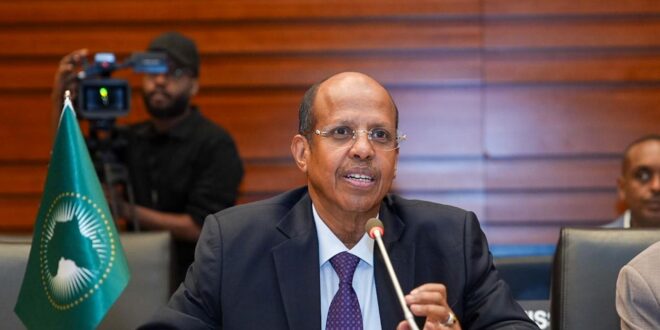
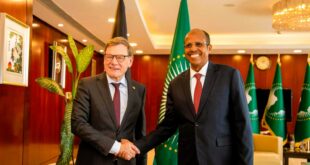
Germany is sending an important diplomatic signal on its future engagement with Africa as Chancellor Friedrich Merz is set to receive Mahmoud Ali Youssouf, Chairperson of the African Union (AU) Commission, at the Federal Chancellery on 14 April.
The planned meeting, which precedes a major international conference on Sudan in Berlin the following day, is being closely watched by business and policy circles as a test of Germany’s commitment to strengthening ties with Africa at a time of shifting global dynamics.
The Afrika-Verein der deutschen Wirtschaft (German-African Business Association) has welcomed the upcoming talks, describing them as a “crucial signal” that Africa is gaining strategic importance in Berlin.
“Africa is already a key pillar for diversification, growth and resilience for German companies,” said Claudia Voß, the association’s chief executive. She emphasised that political engagement must now lead to concrete outcomes — including improved investment frameworks, stronger trade relations and closer institutional cooperation with the African Union.
For years, stakeholders have criticised the lack of consistent high-level political attention given to visiting African leaders in Germany. Against this backdrop, the scheduled reception of the AU Commission chair at the Chancellery is being interpreted as a shift towards more structured and sustained dialogue.
The timing of the visit adds to its significance. On 15 April, Berlin will host an international Sudan conference, co-hosted by Germany and partners, with Youssouf participating in his capacity as a key continental actor. The conference aims to address the ongoing crisis in Sudan, where conflict has triggered one of the world’s most severe humanitarian emergencies, displacing millions and destabilising the wider region.
Germany’s decision to engage the African Union leadership ahead of the conference highlights the organisation’s central role in conflict resolution and peacebuilding on the continent. Observers say closer coordination with the AU is essential for any sustainable international response to crises such as Sudan.
Beyond security issues, the anticipated Merz–Youssouf talks are expected to touch on broader themes shaping Africa-Europe relations, including trade, investment, energy cooperation and supply chain resilience. With Africa’s population and markets expanding rapidly, German policymakers increasingly see the continent as a vital partner in navigating global economic uncertainties.
Business leaders are urging the government to ensure that the political momentum generated by the meeting translates into tangible economic cooperation. Reducing bureaucratic barriers, facilitating private-sector engagement and creating stable investment environments remain top priorities.
As Berlin positions itself for a more proactive Africa policy, next week’s engagements — both the bilateral meeting and the Sudan conference — could mark an important step towards a more consistent and mutually beneficial partnership between Germany and the African continent.
Felix Dappah