 THE AFRICAN COURIER. Reporting Africa and its Diaspora! The African Courier is an international magazine published in Germany to report on Africa and the Diaspora African experience. The first issue of the bimonthly magazine appeared on the newsstands on 15 February 1998. The African Courier is a communication forum for European-African political, economic and cultural exchanges, and a voice for Africa in Europe.

COMMENTARY By Amal Abbass*
On 25 March 2026, the United Nations General Assembly adopted a resolution recognizing the transatlantic trade in enslaved Africans and racialized chattel enslavement as the “gravest crime against humanity.” Though non-binding, the resolution explicitly links historical recognition to reparatory justice, including apology, restitution, compensation, institutional reform and the return of cultural property.
This article argues that the political significance of the resolution lies less in symbolic recognition itself than in the resistance it provoked. The abstention of most European states and the opposition of the United States reveal the limits of Western moral politics when acknowledgment approaches material consequence.
Drawing on Black radical thought, decolonial theory and contemporary reparations debates, the article situates slavery within a continuous structure of colonial extraction and racial capitalism. It further argues that meaningful reparations must address not only economic dispossession, but also gendered violence, epistemic exclusion and governance. Without structural redistribution and shared authority, recognition risks functioning as managed memory rather than transformative justice.
- Introduction: Recognition and Its Limits
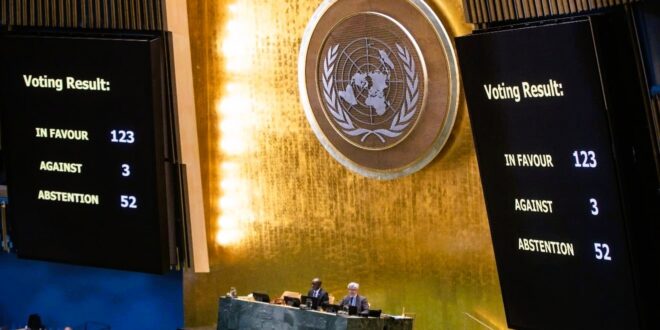
On 25 March 2026, the United Nations General Assembly adopted a resolution introduced by Ghana recognizing the transatlantic trade in enslaved Africans and racialized chattel enslavement as the “gravest crime against humanity.” The resolution passed with 123 votes in favour, 3 against and 52 abstentions. The three votes against came from the United States, Israel and Argentina. Most European Union states abstained, as did the United Kingdom.
Though the resolution is not legally binding, it explicitly calls for reparatory justice, including apology, restitution, compensation, rehabilitation, satisfaction, guarantees of non repetition, and the return of cultural property and archives.
This is a significant political moment. It signals that a broad coalition of states is no longer willing to accept Western dominance over how historical injustice is named, interpreted and limited.
But recognition alone does not produce justice.
The significance of the vote lies not only in its passage, but in the resistance it provoked. The central question is therefore not simply whether slavery is acknowledged, but whether that acknowledgment is allowed to produce consequence.
- Western Abstention and the Politics of Containment
European governments justified their abstention by arguing that describing slavery as the “gravest” crime against humanity risked establishing a hierarchy of suffering. United States representatives also objected to what they framed as the retroactive application of international law. Formally, these were presented as legal and conceptual concerns. Politically, they functioned as forms of containment.
The vote exposed not a simple divide between “the West” and the rest, but a fault line between states willing to expand the political meaning of historical injustice and states invested in limiting the precedents that acknowledgment might create. What was at stake was not memory in the abstract, but the possibility that memory could generate claims over law, resources, and institutional power.
Most European Union member states abstained, suggesting a coordinated political posture rather than a series of isolated national decisions. At the same time, abstention was not limited to Western states. That matters. It suggests that the divide revealed by the vote is not merely geographical. It is structural. It reflects differing positions within a global order organized around legal precedent, economic protection, diplomatic calculation and unequal exposure to claims for redistribution.
If the issue were purely terminological, compromise could have been reached earlier. Resistance intensified precisely where symbolic recognition touched the prospect of material consequence. Abstention, in this context, functioned less as neutrality than as a strategy for containing the legal and distributive implications of recognition.
Western states are increasingly willing to acknowledge historical injustice in moral language. They remain far less willing to accept frameworks that would redistribute resources, authority, or accountability. Recognition is permitted. Structural consequence is resisted.
- Slavery, Colonialism and Racial Capitalism
Slavery cannot be understood as an isolated atrocity. It was constitutive of global capitalism, imperial expansion and modern racial hierarchy.
Walter Rodney showed that Africa’s underdevelopment was not natural or accidental, but historically produced through slavery, extraction and colonial rule. Samir Amin placed this process within a wider history of unequal accumulation on a world scale. Cedric J. Robinson went further, arguing that capitalism did not simply become racial after the fact, but emerged through racialized domination. Frantz Fanon, in turn, insisted that colonial power survives formal independence, reorganizing authority long after the imperial flag has fallen.
From this perspective, slavery and colonialism are not separate histories. They are structurally continuous. The transatlantic slave trade cannot be reduced to one atrocity among others. It played a distinctive role in financing European accumulation, feeding plantation economies, shaping industrial expansion and consolidating modern racial categories. This does not erase the violence of trans-Saharan slave trade or Indian Ocean systems of enslavement. It does, however, clarify the structural specificity of the Atlantic system in the making of global capitalism.
To name slavery in this way is therefore not only to look backward. It is to identify the historical foundations of present arrangements. Racial capitalism is not a metaphor. It names an order in which wealth, dispossession, labour and humanity have long been distributed through racial hierarchy.
- Gendered Violence and Social Reproduction
This continuity becomes even clearer when the gendered dimensions of slavery are taken seriously.
Slavery was not only a regime of forced labour. It was also a regime of reproductive control, sexual violence, kinship destruction and the violent reorganization of social life. Enslaved women were exploited not only as workers, but as bodies through which property relations, inheritance and social reproduction were regulated. Colonial rule later extended these reorderings by imposing patriarchal legal and moral systems that redefined family, gender, sexuality and authority.
Oyèrónkẹ́ Oyěwùmí has shown that colonialism imposed rigid Western gender categories onto African social worlds that were not originally organized in the same way. Sylvia Tamale has further demonstrated how colonial moral regimes continue to structure law, embodiment and everyday relations across the continent and the diaspora.
This means that reparations cannot be limited to compensation for stolen labour or land. They must also address the destruction and regulation of kinship, reproduction and bodily autonomy. Any reparative framework that addresses economic dispossession while ignoring sexual violence, reproductive coercion, kinship rupture, and the colonial ordering of gender remains structurally incomplete.
- Representation and Epistemic Authority
The limits of recognition are also visible in representation.
Contemporary reporting on slavery and colonialism still often relies on inherited visual grammars in which Black subjects appear primarily as violated bodies rather than as historical agents. Even when such imagery is intended to condemn violence, it can reproduce an older politics of spectatorship in which Black suffering is made visible while Black authority is displaced.
As Valentin Yves Mudimbe argued, Africa has repeatedly been produced as an object rather than a subject of knowledge. Ariella Aïsha Azoulay similarly shows that imperial archives do not merely preserve history. They organize it. They authorize particular ways of seeing, knowing, and legitimizing the relation between observer and observed.
The issue, then, is not only whether violence is shown, but how it becomes legible. If Black suffering is repeatedly mediated through scenes of supplication, subordination or anonymous victimhood, then historical recognition risks reproducing the hierarchy it claims to expose. Representation is not secondary to reparations. It is one of the terrains on which authority is either preserved or contested.
- Reparations Beyond Symbolism
If slavery and colonialism are structurally continuous, reparations cannot remain symbolic.
Legal scholars such as M. Cherif Bassiouni have argued that crimes against humanity carry enduring implications for remedy, responsibility, and redress. More recent reparations frameworks, including the work of the CARICOM Reparations Commission, have made clear that reparations can be articulated in institutional and policy terms rather than left as abstract moral language.
A meaningful reparative framework must include, at minimum, land restitution, restitution of cultural artifacts and human remains, debt cancellation and financial restructuring, intellectual property reform and technology transfer, long term investment in education, research, healthcare and infrastructure, archival repatriation and unrestricted access to records produced through colonial rule, and institutional reform in museums, universities, development agencies, and international legal bodies.
As Felwine Sarr and Bénédicte Savoy have argued, restitution is not simply about the return of objects. It is about sovereignty, authority and the right to determine the meaning of one’s own cultural and historical inheritance.
These are not acts of charity. They are mechanisms of structural correction.
- Institutionalizing Reparations: AU Strategy and Black Atlantic Alignment
The UN resolution does not emerge in isolation. It forms part of a broader institutional shift led by the African Union. The AU designated 2025 as the theme year “Justice for Africans and People of African Descent Through Reparations,” and current AU materials indicate a move towards a longer reparations framework beginning in 2026.
What matters politically is not only the symbolism of these declarations, but the institutional architecture now being built around them. The broader point is clear even where official materials vary in how they describe the longer timeline: reparations are being institutionalized as a continental political project rather than left at the level of moral appeal. AU documents frame reparations in relation to transatlantic enslavement, colonialism, apartheid and continuing structures of injustice.
Crucially, this agenda has also developed in alignment with Caribbean reparations politics. The resolution reflects a wider African and Caribbean push in which Ghana, the African Union and CARICOM are acting within an increasingly coordinated reparatory discourse.
Seen in this context, the resistance of Western states at the United Nations appears less as a disagreement over terminology than as a response to an increasingly organized effort to translate historical recognition into claims over law, redistribution and global governance.
Whether these institutional mechanisms will generate enforceable outcomes remains an open question. But their existence already alters the terrain of debate. Reparations are no longer framed only as retrospective moral appeals. They are increasingly being articulated as coordinated political demands.
- Reparations in Practice: Namibia, Cameroon and Ghana
The case of Namibia is central because it exposes the difference between acknowledgment and reparative justice. Germany formally recognized the genocide of the Ovaherero and Nama and pledged funding, yet it framed its response as development cooperation rather than legally grounded reparations. Representatives of affected communities argued that they were marginalized in the negotiation process and that land return, a core issue of dispossession, remained largely unaddressed.
This exclusion is not incidental. It reflects a broader pattern in which recognition is granted while authority over its meaning remains with states and diplomatic elites. In such cases, reparations risk becoming instruments of management rather than mechanisms of justice.
Cameroon raises a different but related problem. Under German colonial rule, forced labour, military violence, land seizure and extractive infrastructure were not isolated abuses but part of a wider system of colonial accumulation. A meaningful reparative framework in Cameroon would therefore have to go beyond apology. It would need to include community led land processes, unrestricted archival access, restitution of looted objects and human remains, and institutional investment governed locally rather than externally. The issue is not memory alone, but whether those historically dispossessed gain power over land, knowledge, and infrastructure in the present.
Ghana occupies yet another position. It is not only a site of historical injury, but also a site of political articulation. As the state that introduced the 2026 UN resolution, Ghana represents a broader effort to move reparations from moral language into multilateral strategy. In this context, reparations in Ghana must be understood not only in terms of return and restitution, but also in relation to pan African institutional futures, including museums, archives, research infrastructures, educational networks, and political forums capable of shifting who defines history and who governs its afterlives.
These cases show that reparations cannot take one universal form. But across contexts, the underlying principle is the same: reparative justice must be historically specific, politically negotiated with affected communities, and structurally redistributive. Anything less leaves intact the hierarchy it claims to address.
- Governance, Diaspora, and Redistribution
Reparations are not only about resources. They are about power.
The exclusion of Ovaherero and Nama communities demonstrates how easily reparative language can reproduce inequality if decision making remains concentrated in states, ministries, diplomats and international elites. A meaningful reparative framework must therefore include shared governance over reparations funds, restitution processes, land commissions, archival access, educational institutions, and monitoring bodies. Without decision making power for affected communities, reparations risk becoming another administrative exercise managed from above rather than a process of historical redress.
This must also include continental and diasporic participation in the design, allocation, and oversight of reparative mechanisms. Reparative justice must address displacement not only symbolically, but materially, by enabling diaspora communities to return, contribute, and shape the conditions of belonging through citizenship pathways, economic support, institutional inclusion, and meaningful participation in governance.
Those historically displaced cannot remain outside the institutions that claim to repair displacement.
- Conclusion: Recognition or Transformation?
The UN resolution marks both a shift and a limit.
It marks a shift in global consensus around the political language of slavery and reparative justice. But it also reveals a limit in the willingness of powerful states to allow recognition to generate consequence. The vote was historic. The resistance was clarifying.
Recognition becomes politically acceptable when it remains symbolic. The resistance to this resolution began at the point where memory threatened to become redistribution.
If slavery is the gravest crime against humanity, then its consequences cannot remain outside the scope of response. If colonialism belongs to the same historical structure, then reparations cannot remain confined to apology or commemorative speech.
If recognition is severed from redistribution, it does not undo historical injustice. It reorganizes its legitimacy.

* The author, Amal Abbass, is a transcultural sandplay therapist, social entrepreneur and co-founder of tubman.network e.V. For decades, she has been a leading advocate for equality and intersectional justice, developing creative, community-rooted initiatives that empower Black and migrant communities. Abbass’s work is grounded in deep expertise in decolonial analysis, systemic critique and anti-racist psychopedagogy. She also integrates diaspora theory into her practice, enriching her therapeutic and social-impact work with global, historically informed perspectives.
________
Bibliography
Amin, Samir. Accumulation on a World Scale: A Critique of the Theory of Underdevelopment. New York: Monthly Review Press, 1974.
Azoulay, Ariella Aïsha. Potential History: Unlearning Imperialism. London: Verso, 2019.
Bassiouni, M. Cherif. Crimes Against Humanity in International Criminal Law. 2nd ed. The Hague: Kluwer Law International, 1999.
Beckles, Hilary McD. Britain’s Black Debt: Reparations for Caribbean Slavery and Native Genocide. Kingston: University of the West Indies Press, 2013.
Césaire, Aimé. Discourse on Colonialism. New York: Monthly Review Press, 1972.
Cooper, Frederick. Colonialism in Question: Theory, Knowledge, History. Berkeley: University of California Press, 2005.
Fanon, Frantz. The Wretched of the Earth. New York: Grove Press, 1963.
Gilroy, Paul. The Black Atlantic: Modernity and Double Consciousness. Cambridge, Massachusetts: Harvard University Press, 1993.
Hartman, Saidiya V. Lose Your Mother: A Journey Along the Atlantic Slave Route. New York: Farrar, Straus and Giroux, 2007.
Hartman, Saidiya V. Scenes of Subjection: Terror, Slavery, and Self Making in Nineteenth Century America. New York: Oxford University Press, 1997.
Mbembe, Achille. On the Postcolony. Berkeley: University of California Press, 2001.
Mudimbe, V. Y. The Invention of Africa: Gnosis, Philosophy, and the Order of Knowledge. Bloomington: Indiana University Press, 1988.
Ndlovu Gatsheni, Sabelo J. Coloniality of Power in Postcolonial Africa: Myths of Decolonization. Dakar: CODESRIA, 2013.
Nkrumah, Kwame. Neo Colonialism: The Last Stage of Imperialism. London: Thomas Nelson & Sons, 1965.
Ogletree, Charles J., Jr., and Austin Sarat, eds. From Here to Equality: Reparations for Black Americans in the Twenty First Century. Durham, North Carolina: Duke University Press, 2020.
Oyěwùmí, Oyèrónkẹ́. The Invention of Women: Making an African Sense of Western Gender Discourses. Minneapolis: University of Minnesota Press, 1997.
Robinson, Cedric J. Black Marxism: The Making of the Black Radical Tradition. Chapel Hill: University of North Carolina Press, 1983.
Rodney, Walter. How Europe Underdeveloped Africa. London: Bogle L’Ouverture, 1972.
Sarr, Felwine, and Bénédicte Savoy. The Restitution of African Cultural Heritage: Toward a New Relational Ethics. Report submitted to the President of the French Republic, 2018. Full text: https://restitutionreport2018.com/sarr_savoy_en.pdf
Sharpe, Christina. In the Wake: On Blackness and Being. Durham, North Carolina: Duke University Press, 2016.
Tamale, Sylvia, ed. African Sexualities: A Reader. Cape Town: Pambazuka Press, 2011.
Tamale, Sylvia. Decolonization and Afro Feminism. Ottawa: Daraja Press, 2020.
Tuck, Eve, and K. Wayne Yang. “Decolonization Is Not a Metaphor.” Decolonization: Indigeneity, Education and Society 1, no. 1 (2012): 1 to 40. Full text: https://jps.library.utoronto.ca/index.php/des/article/view/18630
Williams, Eric. Capitalism and Slavery. Chapel Hill: University of North Carolina Press, 1944.
Wynter, Sylvia. “Unsettling the Coloniality of Being, Power, Truth, Freedom: Towards the Human, After Man, Its Overrepresentation. An Argument.” CR: The New Centennial Review 3, no. 3 (2003): 257 to 337.
Policy and Primary Sources
African Union. “AU Theme of the Year 2025: Justice for Africans and People of African Descent Through Reparations.” https://au.int/en/theme/2025
African Union. “Accra Proclamation on Reparations.” https://au.int/en/decisions/accra-proclamation-reparations
African Union Commission. “Statement of the Chairperson of the AU Commission on the Adoption of UN General Assembly Resolution A/80/L.48.” https://au.int/en/pressreleases/20260326/auc-chairperson-statement-adoption-un-general-assembly-resolution-a80l48
United Nations General Assembly. Draft Resolution A/80/L.48. https://docs.un.org/en/A/80/L.48
CARICOM Reparations Commission. “CARICOM’s Ten Point Plan for Reparatory Justice.” https://caricomreparations.org/caricom/caricoms-10-point-reparation-plan/
Reuters. “UN adopts Ghana’s slavery resolution, defying resistance from US, Europe.” 25 March 2026. https://www.reuters.com/sustainability/society-equity/un-adopts-ghanas-slavery-resolution-defying-resistance-us-europe-2026-03-25/
Reuters. “Ghana to submit UN resolution on slavery reparations, eyes broad support.” 12 March 2026. https://www.reuters.com/sustainability/society-equity/ghana-submit-un-resolution-slavery-reparations-eyes-broad-support-2026-03-12/
Associated Press. “UN calls for reparations to remedy the historical wrongs of trafficking enslaved Africans.” 25 March 2026. https://apnews.com/article/a7497cdb7d24a89eedb50beb683adc0f
European External Action Service. “EU Explanation of Vote at the UN General Assembly on A/80/L.48.” https://www.eeas.europa.eu/delegations/un-new-york/eu-explanation-vote-%E2%80%93-un-general-assembly-action-a80l48-declaration-trafficking-enslaved-africans_en?s=63