 THE AFRICAN COURIER. Reporting Africa and its Diaspora! The African Courier is an international magazine published in Germany to report on Africa and the Diaspora African experience. The first issue of the bimonthly magazine appeared on the newsstands on 15 February 1998. The African Courier is a communication forum for European-African political, economic and cultural exchanges, and a voice for Africa in Europe.

By Felix Dappah, The African Courier
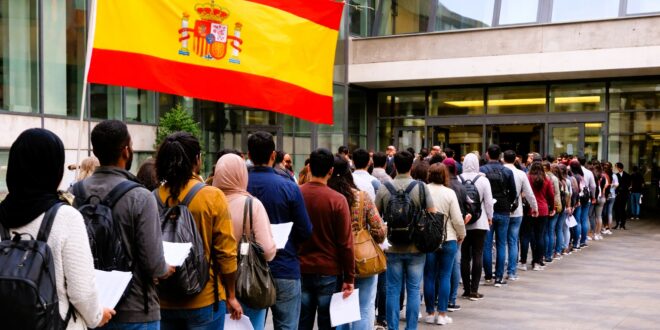
In a move that has set Spain apart from virtually every other government in Europe, Prime Minister Pedro Sánchez’s administration has formally launched a mass regularisation programme for undocumented migrants, opening application windows on 16 April 2026 for online submissions and 20 April for in-person filings. The application period runs until 30 June 2026.
The scheme — officially known as the Proceso de Regularización Extraordinaria, or Extraordinary Regularisation Process — was fast-tracked via a royal decree, bypassing Spain’s parliament, where Sánchez’s minority government does not hold a majority. An earlier attempt to push the measure through the legislature had failed. The decree amends existing immigration law and gives the government the authority to act without a full parliamentary vote.
Who Is Eligible?
To qualify, applicants must prove they arrived in Spain before 1 January 2026 and have been continuously resident in the country for a minimum of five months. A clean criminal record is also required. Those whose applications succeed will initially receive a one-year residency and work permit, after which they will be able to apply for other standard residency or employment permits under existing immigration rules.
Proof of residence can be established through documentation such as municipal registration records, rental contracts, or employment-related paperwork. The process is designed to be primarily digital, reflecting a deliberate effort to make applications accessible and efficient. Crucially, the scheme covers only those already living in Spain.
Key Facts: Spain’s Regularisation Scheme
- Applications open: 16 April (online), 20 April (in person)
- Deadline: 30 June 2026
- Requirement: In Spain before 1 January 2026, resident 5+ months, clean criminal record
- Outcome: 1-year residency + work permit, renewable
The Scale of the Scheme
The Spanish government estimates that approximately 500,000 people could be eligible to apply. However, that figure is contested. The Spanish think tank Funcas has put the total undocumented population in Spain at around 840,000, while separate police analyses suggest the number who could potentially qualify may be up to three times higher than official projections. Analysts widely expect the government’s estimate to prove conservative once the application process concludes.
Prime Minister Sánchez has framed the measure in economic terms as much as humanitarian ones, arguing that Spain cannot afford to leave so large a portion of its working population outside the formal economy. He described the programme as an “act of justice and a necessity,” pointing to Spain’s status as the fastest-growing economy in the European Union and attributing much of that dynamism to its migrant workforce.
Migration Minister Elma Saiz echoed this framing, linking regularisation to the health of Spain’s welfare state. Spain needs an estimated 250,000 new registered foreign workers each year simply to sustain its social security and pension systems, she has noted in previous statements. The country’s population has grown sharply in recent years to reach around 50 million, with approximately one in five residents now born outside Spain.
What This Means for the African Diaspora
While the largest undocumented communities in Spain come from Latin American countries — principally Colombia, Venezuela, and Ecuador — African nationals form a substantial and highly visible portion of those expected to apply. Moroccans constitute the largest single African community in Spain, with Algerians, Senegalese, Nigerians, Malians, Guineans and Ivorians also well represented. Across these communities, many people work in agriculture, construction, domestic care, hospitality and tourism — sectors that are heavily dependent on informal labour.
Reports from Spanish cities in the days following the announcement confirmed that large crowds had already begun forming outside Moroccan, Algerian and other African consulates across the country, as applicants sought to obtain criminal record certificates from their countries of origin — a necessary document for the application. The scenes underscored both the urgency and the practical hurdles facing many would-be applicants, particularly those whose consular services are poorly resourced or slow to process requests.
For sub-Saharan Africans specifically, the pathway to Spain has often been long and dangerous. Many have travelled overland through Mali, Niger or Mauritania to Morocco, with the Atlantic route from Senegal to Spain’s Canary Islands remaining one of the deadliest irregular migration corridors in the world. Having survived that journey and built lives in Spain — often for years — a formal legal status would represent a profound transformation in their circumstances: access to banking, healthcare, education for their children, and freedom from the constant threat of detention and deportation.
A Political Battle — and a European Outlier
The scheme has ignited fierce domestic opposition. Alberto Núñez Feijóo, leader of the centre-right People’s Party, denounced it as “inhumane, unfair, unsafe, and unsustainable” — a characterisation that drew sharp responses from the government, which noted that the People’s Party itself carried out two large-scale migrant legalisations when it was in office in the early 2000s.
Immigration officers’ unions also raised concerns, warning that the government has not provided adequate staffing or resources to process applications on the scale expected. The workload implications of processing potentially hundreds of thousands of applications within a ten-week window are considerable, and civil servants have made clear they expect the system to face severe strain.
Beyond domestic politics, Spain’s decision places it in sharp contrast with the broader European mood. The EU’s Pact on Migration and Asylum — which comes into full force in June 2026 — emphasises tighter external border controls, faster returns and mandatory solidarity mechanisms for managing asylum flows. Spain is among the bloc’s most exposed frontline states for irregular arrivals, yet its government has chosen to respond with integration rather than exclusion.