 THE AFRICAN COURIER. Reporting Africa and its Diaspora! The African Courier is an international magazine published in Germany to report on Africa and the Diaspora African experience. The first issue of the bimonthly magazine appeared on the newsstands on 15 February 1998. The African Courier is a communication forum for European-African political, economic and cultural exchanges, and a voice for Africa in Europe.

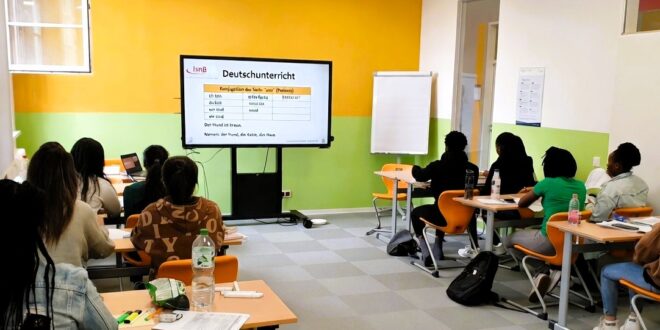
Since the beginning of 2026, the Federal Office for Migration and Refugees (BAMF) has suspended all new admissions to integration courses under Section 44, paragraph 4 of the German Residence Act (AufenthG).
The circular, sent to course providers on 9 February, clarifies that this freeze affects asylum-seekers, tolerated residents (Geduldete), Ukrainians with temporary protection and EU citizens, who had previously relied on voluntary access to courses with available places. Already granted participation approvals remain valid, and providers can accept applicants as self‑paying participants, but state-funded access is currently unavailable, the letter explained.
BAMF cites financial challenges in recent years as the primary reason for the freeze. According to the letter, the long duration of integration courses often results in expenses spilling over into following years, creating budgetary risks. The agency states that aligning admissions with available federal funds is necessary to maintain a sustainable financing system for the courses and ensure that all existing obligations and claims can be properly paid to course providers.
“While this decision limits access for many potential participants, it is intended to safeguard the integration course system for the long term,” the BAMF stated, emphasizing that future course development will focus on reducing system complexity and improving predictability and manageability.
Integration courses, introduced under the 2005 Immigration Act, combine German language instruction (typically 600–900 lessons) with orientation classes (100 lessons) on German law, culture, history, and everyday life. Successful completion requires passing the Deutsch-Test für Zuwanderer (DTZ) and the Leben in Deutschland test. In 2024, roughly 363,500 people participated in integration courses, with around 40% attending voluntarily. For 2026, BAMF had projected 314,300 participants, of which roughly 40% would have been voluntary applicants now affected by the freeze.
The decision has drawn strong criticism from course providers and political representatives. The German Adult Education Association (DVV) warns that halting voluntary participation risks undermining entire courses, as minimum enrollment numbers may no longer be met. This, in turn, could affect those who are legally required to attend, while teachers and course operators face financial uncertainty.
Even within Germany’s ruling coalition, debate continues. Some federal and regional lawmakers argue that integration courses must remain broadly accessible to ensure language proficiency, economic participation and civic inclusion. Ahead of upcoming integration minister conferences, several state leaders have pledged to urge a reversal or mitigation of the freeze.
Under current regulations, some migrants have a legal right to attend courses; others can do so voluntarily if space is available. Those with an entitlement typically include people with permanent or long‑term residence permits. In contrast, groups such as asylum-seekers still in process, tolerated residents (Geduldete), Ukrainians with temporary protection, and EU citizens have traditionally participated only if they applied for admission under Section 44, paragraph 4 of the Residence Act, which allows voluntary access. That pathway — and with it the hope of learning German at state expense — has now been halted.
For many, the suspension therefore represents a barrier to opportunity. Without access to courses that build German language skills, many migrants will find it harder to secure jobs, access services, participate socially or complete mandatory requirements connected with residence status. As providers warn of a widening gap in access, community leaders in Germany’s diverse migrant population have urged policymakers to find urgent solutions — before the cost‑savings of today become the social and economic costs of tomorrow.
Vivian Asamoah