 THE AFRICAN COURIER. Reporting Africa and its Diaspora! The African Courier is an international magazine published in Germany to report on Africa and the Diaspora African experience. The first issue of the bimonthly magazine appeared on the newsstands on 15 February 1998. The African Courier is a communication forum for European-African political, economic and cultural exchanges, and a voice for Africa in Europe.

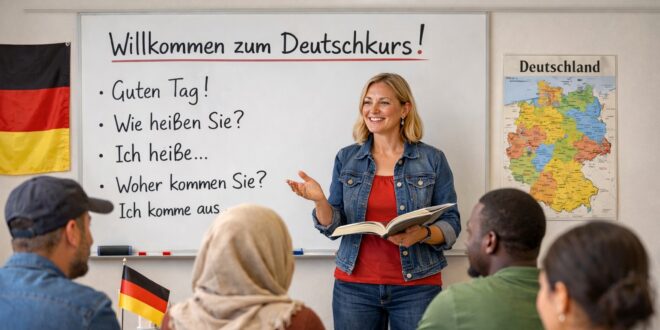
New admissions to federally funded Integrationskurse (integration courses) have been suspended, leaving many refugees and migrants unable to begin essential German language and cultural orientation classes. The freeze, implemented quietly by the Federal Office for Migration and Refugees (BAMF) at the end of 2025, remains in place with no clear timeline for resumption.
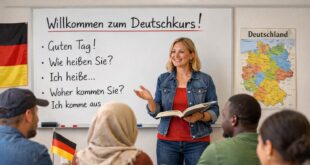
Integration courses are government-supported programmes designed to help migrants and refugees learn the German language and understand everyday life, culture, law and history in Germany. They aim to equip newcomers with the skills needed to participate in society and manage daily life independently.
According to reports, course providers across the country — including adult education centres (Volkshochschulen) and independent language institutes — were not informed in advance of the decision. Despite having available places and eligible applicants on waiting lists, many courses cannot begin because official approvals are currently not being issued.
The admissions freeze is already having a ripple effect. Some classes that enrolled students before the suspension are now under-filled and are being postponed or cancelled altogether. Teachers and course providers report growing planning uncertainty, financial pressure and confusion about the future of their programmes.
Although the federal budget for integration courses in 2026 remains high — at just over one billion euros — signalling continued commitment at national level, some states have sharply reduced their support. In Saxony, for example, the state government has cut funding for local integration projects by around 80 percent this year.
Officials at BAMF and the Federal Interior Ministry say the decision reflects broader policy adjustments, including efforts to better align course availability with migrants’ prospects of long-term residence in Germany. A ministry spokesperson also suggested that recent declines in immigration figures could justify a reduction in course numbers, though details remain unclear.
For refugees and migrants hoping to improve their language skills and integrate more easily into German society, the freeze could mean weeks or even months of waiting without access to structured learning. Without valid admission approvals, many cannot begin courses that are often prerequisites for employment, civic participation and long-term residence or naturalisation.
Legal Basis of Integration Courses
The legal foundation for integration courses is set out in the German Residence Act (Aufenthaltsgesetz), particularly Sections 43 and 44, and further regulated by the Integration Course Ordinance (Integrationskursverordnung, IntV). The courses were introduced in 2005 as part of Germany’s Immigration Act and have since become a central pillar of the country’s integration policy.
Structure and Content of the Courses
Integration courses typically consist of two main components:
🔹 Language Training (600–900 units)
Most courses include 600 lesson units of language instruction, aimed at helping participants reach B1 level of the Common European Framework of Reference for Languages (CEFR). Special courses — for example for beginners, women, parents or people with literacy needs — may extend to up to 900 units.
🔹 Orientation Course (100 units)
This component covers Germany’s legal system, history, culture, social norms and everyday life.
At the end of the course, participants take the ‘Deutsch-Test für Zuwanderer’ (DTZ) and the “Leben in Deutschland” (Life in Germany) test to demonstrate their language skills and knowledge of German society.
How Many People Take Integration Courses?
Before the current admissions freeze, participation levels were high. Around 363,000 people began integration courses in both 2023 and 2024, making these some of the largest cohorts in recent years. For 2025, BAMF expected about 326,000 participants, while projections for 2026 stand at around 314,000.
These figures underline the importance of integration courses as one of the most widely used integration-support services for migrants in Germany.
Who Must or Can Attend?
Participation in integration courses can be mandatory or voluntary, depending on a person’s residence status:
- Migrants with certain residence permits, especially those expected to stay long-term, may be legally required to attend.
- People with a Duldung (tolerated stay) who are likely to remain in Germany can also apply.
- EU citizens and other migrants without a formal entitlement may be admitted if places are available, subject to BAMF approval.
- Some groups, such as full-time employees or people in vocational training, may be exempt.
- Children and young people who attend school are generally not required to take part.
Critics warn
With admissions frozen, thousands of people who want — and need — to attend these courses are now unable to start learning German and adapting to life in Germany. At the same time, course providers are grappling with cancellations and planning uncertainty, while many prospective students remain stuck on waiting lists despite having the required documents and strong motivation to integrate.
Critics warn that delaying access to language education will undermine long-term integration and reduce migrants’ chances of entering the labour market — particularly at a time when Germany is facing persistent skilled-labour shortages.
Vivian Asamoah