 THE AFRICAN COURIER. Reporting Africa and its Diaspora! The African Courier is an international magazine published in Germany to report on Africa and the Diaspora African experience. The first issue of the bimonthly magazine appeared on the newsstands on 15 February 1998. The African Courier is a communication forum for European-African political, economic and cultural exchanges, and a voice for Africa in Europe.

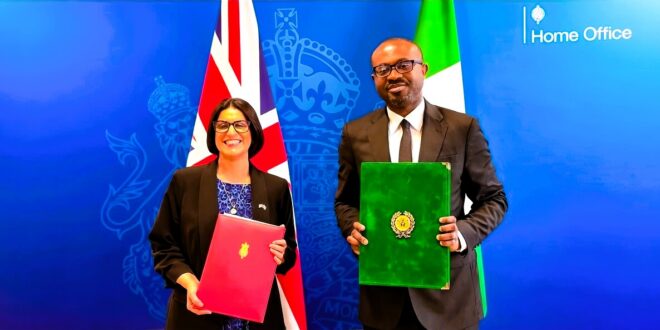
Signed on the margins of President Tinubu’s state visit to London, one landmark agreement on migration and two MoUs on organised crime and business visas carry real implications for Nigerians at home and in the diaspora
During President Bola Tinubu’s two-day state visit to the United Kingdom, both countries signed an agreement establishing a comprehensive bilateral framework for managing migration, an outcome analysts say may prove to be one of the most consequential of the high-profile trip.
In formal terms, the deal, signed by Nigeria’s Minister of Interior, Olubunmi Tunji-Ojo, and the UK Home Secretary, Shabana Mahmood, commits both governments to a migration system that is safe, orderly and regulated, anchored in international human rights law and the national legislation of each country.
The stated aim is to provide legal, protected pathways for Nigerians wishing to work, study or settle in the UK while simultaneously closing off irregular routes exploited by traffickers and criminal networks.
The agreement, however, has a sharp edge that has not been lost on observers. Embedded within it is a provision that will make the deportation of Nigerians without legal status in the UK significantly easier.
For the first time, Nigeria has agreed to recognise “UK letters” — an alternative travel document issued to people without valid passports who are scheduled for deportation. Previously, the UK had to wait for the Nigerian High Commission to issue emergency travel documents on a case-by-case basis, a process British authorities say caused lengthy delays and often allowed deportation proceedings to stall.
Under the new deal, that administrative bottleneck has been removed. The UK Home Office confirmed that annual returns of Nigerians have already nearly doubled to 1,150, a figure likely to rise further as the new mechanism takes effect.
UK Home Secretary Shabana Mahmood was unambiguous in framing the benefit for London. The deal, she said, forms part of sweeping reforms to “secure the UK’s borders and remove incentives attracting illegal migration.” Her Ministry, which is in charge of border security, went further, stating that anyone who “abuses our systems, breaks our laws or tries to cheat their way into Britain will be stopped and removed.”
For the Nigerian government, the framing was different but equally clear. While thousands of Nigerians live and work legally in the UK, many overstay their visas and are therefore considered to be in the country illegally. Others have been convicted of crimes or have had their asylum claims rejected. The new agreement will make it easier to return individuals in these categories to Nigeria.
Reacting to the agreement, Mr Tunji-Ojo said: “For us, as a country, we keep saying that we are totally committed to being a responsible country in fulfilling our core obligations.
“It is good that we are starting this with the UK. This relationship with the UK means a lot to Nigeria. President Bola Ahmed Tinubu has shown great commitment to this.”
In addition to the migration agreement, Nigeria and the UK also signed two Statements of Intent.
One is a three-year strategic plan targeting criminal networks that profit from irregular migration. It envisages joint operations, real-time intelligence sharing and coordinated action against gangs involved in fraudulent visa applications, people smuggling and document forgery.
Following a series of high-profile cases in the UK involving fake job sponsorships, sham marriages and forged financial records, both governments will also introduce a standardised document-checking system to verify the authenticity of visa applications.
Nigeria has further committed to reviewing its domestic laws to ensure that immigration-related crimes carry tougher custodial sentences, signalling Abuja’s readiness to prosecute offenders.
The agreement also extends cooperation to online financial crime. A new joint “fusion cell”, bringing together public-sector agencies, banks, technology firms and telecommunications companies, will share intelligence in near real time to combat romance fraud, investment scams and cryptocurrency-related crimes.
For Nigeria, where the reputational damage caused by internet fraud has long affected its citizens abroad, this provision carries both diplomatic and practical significance.
The second Statement of Intent, signed by Minister Tunji-Ojo and UK Trade Envoy to Nigeria, Florence Eshalomi, expands the existing Business Visa Scheme for UK companies operating in Nigeria. In practical terms, staff of British firms, and their Nigerian partners, will face fewer bureaucratic hurdles when applying for business travel visas. Processing times are expected to improve, and eligibility categories will be broadened.
Sola Jolaoso
READ ALSO Tinubu’s Historic UK State Visit Opens New Chapter for Nigeria–Britain Relations