 THE AFRICAN COURIER. Reporting Africa and its Diaspora! The African Courier is an international magazine published in Germany to report on Africa and the Diaspora African experience. The first issue of the bimonthly magazine appeared on the newsstands on 15 February 1998. The African Courier is a communication forum for European-African political, economic and cultural exchanges, and a voice for Africa in Europe.

Germany’s courts and authorities are sending a clear message: foreign nationals who commit serious crimes can lose their right to stay in the country and face deportation. A recent court ruling in Karlsruhe has renewed debate over how far Germany may go in removing foreigners — especially Syrians — from the country.
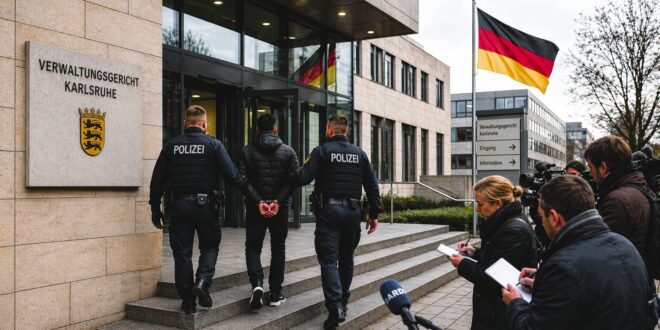
Germany’s Administrative Court in Karlsruhe has issued a significant ruling that reinforces the government’s authority to expel foreign nationals who commit violent crimes. The case centred on a Syrian man who arrived in Germany in 2015 as an eleven-year-old child with his family. He was formally recognised as a refugee and received a temporary residence permit.
In 2024, a regional court in Karlsruhe sentenced him to a multi-year youth custody term after he was found guilty of attempted manslaughter and dangerous bodily harm. Following his imprisonment, he was transferred to a rehabilitation clinic where he is receiving treatment for drug dependency.
Ruling against his lawsuit to block expulsion, the Administrative Court, in its ruling published on Wednesday (April 22), determined that there was a “particularly serious public interest” in removing him from the country. Judges found that the risk he posed to public safety outweighed his personal interest in staying. The court was explicit that its decision was intended to send a message: foreign nationals who commit comparable violent offences face the serious prospect of deportation.
The ruling is not final and can still be appealed. More significantly, before the man could actually be removed to Syria, Germany’s Federal Office for Migration and Refugees (BAMF) would first need to revoke his refugee protection status. That step has not yet been taken. However, the court indicated that such action could be forthcoming, and the ruling makes it legally easier for authorities to proceed.
This signals a shift in how Germany is approaching the intersection of criminal conduct and immigration status. Until recently, protected refugee status provided a strong barrier against removal. That barrier is now being tested.
What This Means for Non-Syrian Migrants
While this ruling specifically concerns a Syrian national, its implications extend to all foreign nationals in Germany regardless of nationality. The court’s language was deliberate: it said the judgment was meant to deter all foreign nationals from committing violent crimes by making clear that deportation is a real consequence.
For foreign residents — whether holding refugee status, a Duldung, a temporary residence permit or another form of protection — the key takeaways are consistent with existing German law, but the political climate has sharpened enforcement:
Key Points to Understand
- A criminal conviction for serious offences can trigger deportation proceedings, even if you have refugee or protected status.
- Your protection status is not automatically permanent — it can be reviewed and revoked by BAMF, particularly in the context of criminal conduct.
- A Duldung (tolerated stay) offers limited security and does not equal a residence right.
- Integration — language skills, employment, community ties — is a factor courts may consider, but it does not guarantee protection from removal in serious criminal cases.
- If you are in any doubt about your legal status, consult a qualified immigration lawyer or a recognised refugee counselling centre.
Debate Over Syrians Also Growing
The issue is no longer only about criminals. German Chancellor Friedrich Merz recently suggested that many Syrians in Germany could return home, causing concern among refugee communities. This debate is controversial because Syrians now play an important role in Germany’s labour market.
Hundreds of thousands are employed in Germany, including many in shortage occupations such as healthcare, transport, logistics and skilled trades. In healthcare alone, an estimated 6,000 Syrian doctors are practising in Germany, making them the largest single group of foreign-trained doctors in the country. Any large-scale removal programme would create significant gaps in an already stretched workforce. Many businesses have warned that Germany needs workers and should not push away integrated migrants.
Germany suspended all deportations to Syria between 2012 and 2025, citing the dangers of the civil war. That changed in December 2025, when a convicted offender was deported — the first such case since the conflict began. Three further convicted offenders were removed in January 2026. The numbers remain small, but the political direction is unmistakable.
At the same time, tens of thousands of Syrians remain in legally precarious positions. According to BAMF data from February 2026, more than 10,700 Syrian nationals were officially required to leave Germany. Of these, however, close to 9,800 held a Duldung — a “tolerated stay” status that allows someone to remain temporarily because deportation cannot actually be carried out. A Duldung is not a residence permit; it is a suspension of removal, and it can be withdrawn.
Sola Jolaoso
READ ALSO Spain: Amnesty Programme Offers Legal Status to 500,000 Migrants