 THE AFRICAN COURIER. Reporting Africa and its Diaspora! The African Courier is an international magazine published in Germany to report on Africa and the Diaspora African experience. The first issue of the bimonthly magazine appeared on the newsstands on 15 February 1998. The African Courier is a communication forum for European-African political, economic and cultural exchanges, and a voice for Africa in Europe.


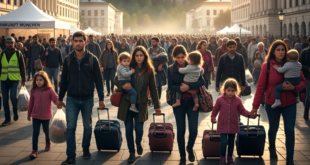
Germany urgently needs immigration to cushion the effects of demographic change and labour shortages. Yet a growing number of people living in the country, particularly those with a migration background, are contemplating the opposite move: leaving Germany altogether.
According to a new short study by the German Centre for Integration and Migration Research (DeZIM), 21 per cent of people living in Germany have at some point considered emigrating. Among Germans without a migration background, the figure stands at 17 per cent. But the numbers rise sharply among immigrants themselves, where 34 per cent have thought about leaving, and even higher among their descendants, at 37 per cent.
The study is based on repeated surveys of nearly 3,000 people conducted between summer 2024 and summer 2025, allowing researchers to track changes over time. While most of those expressing emigration thoughts have no concrete plans, the findings are nonetheless striking. Only about two per cent of respondents said they intended to leave Germany within a year. Still, official statistics show that in 2024 alone, around 1.2 million people actually moved out of the country.
Discrimination a key factor
For many respondents, the main motivation behind emigration thoughts is the hope for a better quality of life. About half of those considering leaving cited this reason. However, among people with a migration history, experiences of discrimination featured prominently as a push factor.
This resonates strongly with recent studies on racism in Germany. Such persistent exclusion not only affects social cohesion but also shapes long-term life decisions, including whether people see a future for themselves in Germany.
The DeZIM study reveals notable differences by region of origin. Emigration considerations were highest among people with family roots in Turkey, the Middle East and North Africa, at 39 per cent. Among those with origins in the former Soviet Union, 31 per cent had considered leaving, while the figure was 28 per cent among migrants from other EU countries.
Political climate matters
One particularly telling finding is the timing of changing attitudes. Researchers observed a sharp increase in emigration considerations shortly before the federal elections in February 2025. During that period, the share of immigrants and their descendants thinking about leaving rose by around ten percentage points. This suggests that heated political debates around migration, identity and belonging have a direct impact on how welcome people feel.
The authors warn that emigration is often overlooked in public discourse, which tends to focus almost exclusively on immigration. Yet in a country facing an ageing population and serious labour shortages, the loss of skilled and motivated residents – many of whom were once actively recruited – could have serious consequences.
The study sends a sobering message: discrimination and exclusion do not just harm individuals; they risk driving people away. Addressing racism and ensuring equal participation may therefore be just as crucial for Germany’s future as attracting new immigrants in the first place.
Vivian Asamoah